

ON THIS PAGE
If you're hunting for Salesloft alternatives in 2026, you've probably hit one of three walls: the renewal quote is up 30%, the AI features feel bolted-on, or you've realized your team is paying enterprise prices for a sequencer they barely fill.
The problem with most "Salesloft alternatives" listicles is that they mix a dozen sequencers, two CRMs, and a conversation intelligence tool into one flat ranking. That doesn't help you decide — it just makes you scroll. We're going to do this differently.
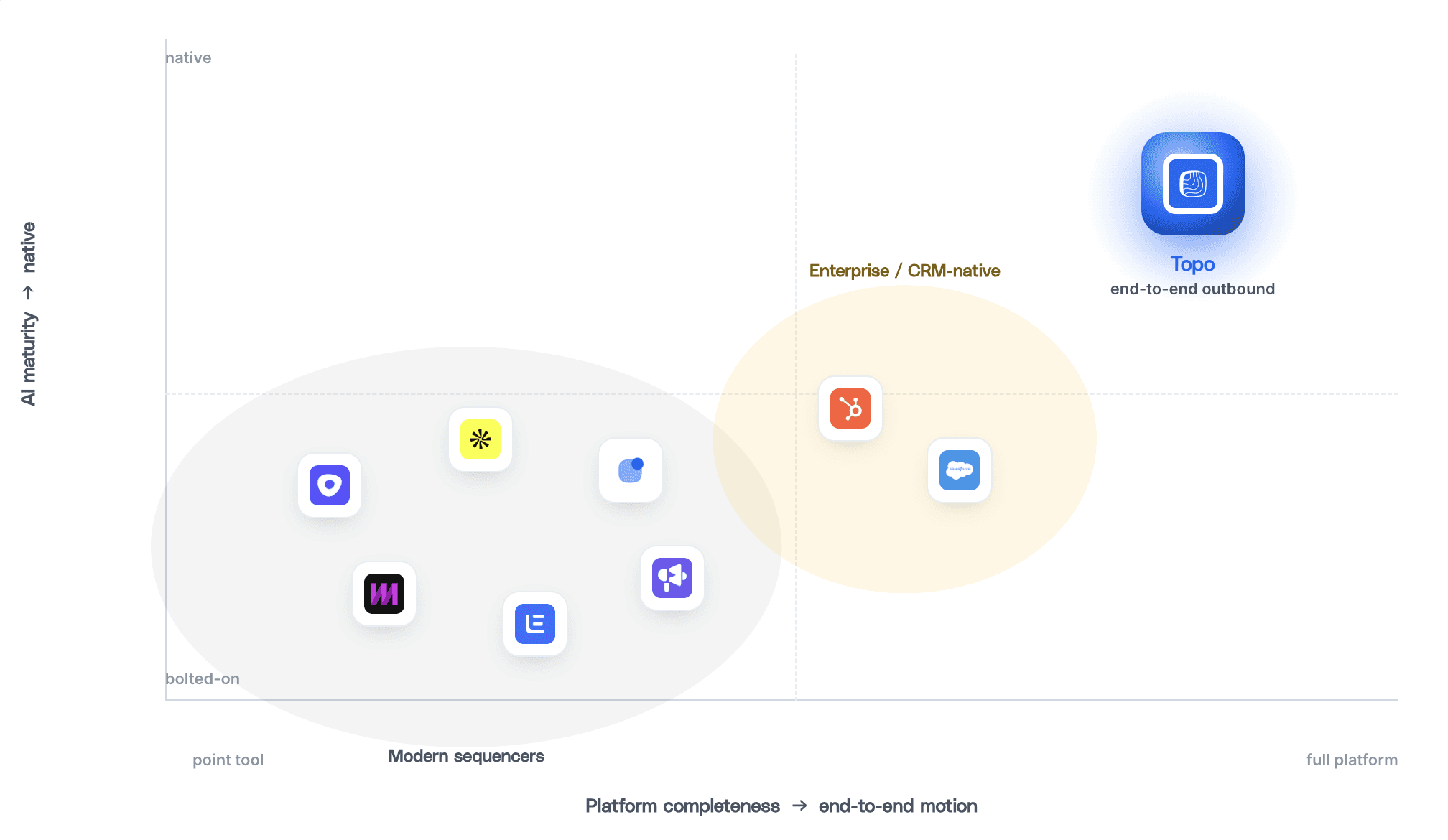
This guide groups 9 Salesloft alternatives by what they're actually built to do, so you match the tool to your motion. We're an end-to-end outbound platform ourselves, so we'll be straight about where we fit and where a sequencer is still the right answer.
Why Teams Leave Salesloft in 2026
Salesloft set the standard for sales engagement a decade ago — multi-step cadences, dialer, analytics, CRM sync. The platform still works. But four pressures are pushing mid-market teams to look elsewhere.
Pricing that's outgrown mid-market. Salesloft contracts routinely land in the $125–$200 per user per month range on annual terms, plus implementation. For a 40-rep team, that's $60k–$100k a year before you account for the dialer add-on, the conversation intelligence add-on, and the connector to your CRM. The math worked at 200 reps; it doesn't work at 40.
Sequencing is the wrong unit of work. Salesloft assumes you already know who to message, when, and why — its job is to fire the cadence. But the modern outbound bottleneck isn't "send more emails." It's "find the 50 accounts ready to talk this week." Volume sequencing without a signal layer underneath is what got everyone's inbox burned in 2024.
AI features that feel retrofitted. Salesloft has added AI summarization, AI reply suggestions, and AI scoring on top of the existing engagement engine. Useful, but bolted-on. AI-native challengers built the platform layer first — which means the AI runs the play, not just commentary on it.
The SDR headcount question. Salesloft is designed for SDR teams that fill cadences manually. The shift in 2026 is that teams running end-to-end outbound platforms reshape what SDR time looks like — less hand-building lists and stitching tools, more time on the conversations that actually book meetings. The tool stops fitting the org chart. If you're measuring the shift, our AI SDR performance KPI guide lays out what to track.
The Gong Engage pull. A newer pressure: teams already running Gong for revenue intelligence are increasingly moving their engagement layer into Gong Engage — one fewer vendor, one fewer contract, and it lives inside a tool reps already know. It's a rational consolidation. What it doesn't change is the layer underneath: you still need a separate answer for who to contact and why now. If you're weighing that move, run it through the same six dimensions below.
Why it matters: teams that move from a Salesloft + SDR-headcount stack to an end-to-end outbound platform consistently report more pipeline per SDR, not because they send more — because they only message accounts that have a reason to talk.
What to Look For in a Salesloft Alternative
Before scanning the list, run your shortlist through these six dimensions. Most teams that switch poorly over-index on per-seat price and under-index on the activation layer underneath.
Signal detection. Funding rounds, hiring waves, tech installs, content engagement — does the tool detect these natively or do you stitch them in via Clay?
Unit of work. Is the tool selling you cadence execution (Salesloft's category) or meetings booked (the end-to-end outbound category)? Different value props, different price tags.
Channel mix. Email-only, email + LinkedIn, or full multichannel with calls and SMS. Most mid-market motions need at least email + LinkedIn out of the box.
AI maturity. Native AI agents vs bolted-on AI features. Test the depth on a free trial — the gap is obvious in 20 minutes.
Pricing model. Per-seat price vs total stack cost. A cheaper seat that still needs a separate data tool and enrichment often costs more overall. Compare on total cost-per-meeting, not per-seat.
CRM sync depth. Field-level writes, dedupe, attribution — especially on HubSpot, where most mid-market teams sit. Anything shallower is a 2020 stack.
The 9 Best Salesloft Alternatives in 2026
We grouped these alternatives by what problem they actually solve. Category 1 is the new shape of outbound. Category 2 is the modern sequencer market. Category 3 is for teams whose CRM is the center of gravity.
Tool | Category | Pricing Model | Best For | AI-Native? |
|---|---|---|---|---|
Topo | End-to-end outbound platform | Per-seat SaaS | Small and Mid Market teams | Yes |
Outreach | Modern sequencer | Custom (mid-market and up) | Larger sales orgs needing deep cadence + AE workflows | Partial |
Apollo.io | Modern sequencer | Freemium + transparent SaaS | Budget-sensitive teams wanting data + sequencing in one tool | Partial |
Mixmax | Modern sequencer | Per-seat SaaS | Gmail-native teams running lighter outbound + AE follow-up | Partial |
Lemlist | Modern sequencer | Per-seat SaaS | SMB and agency teams running creative email-first campaigns | Partial |
Smartlead | Modern sequencer | Volume-based SaaS | Lean teams scaling cold email with deliverability infrastructure | Partial |
Reply.io | Modern sequencer | Per-seat SaaS | Multichannel teams wanting email + LinkedIn + calls in one tool | Partial |
Salesforce Sales Engagement | Enterprise platform | Custom enterprise | Salesforce-anchored enterprise sales orgs | Partial |
HubSpot Sales Hub | Enterprise platform | Per-seat + annual | HubSpot-native teams consolidating sales tech in one suite | Partial |
Full per-tool breakdowns below, grouped by category.
Category 1: End-to-End Outbound Platforms
This is the newest category in the Salesloft replacement market — and the one that confuses the most evaluators, because it doesn't slot into the "sequencer" mental model. End-to-end outbound platforms don't sell you cadences to fill. They run the full motion: sourcing accounts, detecting buying signals, qualifying contacts, drafting and sending hyper-targeted messages across channels, and triaging replies — autonomously, with human-in-the-loop review.
If your bottleneck is finding the accounts worth talking to, this is the right category. If your bottleneck is "my reps don't follow the cadence" or "we need a better dialer," Salesloft or a Category 2 sequencer is a better fit.
1. Topo
Best for: sales teams with 3–20 people doing prospecting, on HubSpot or Salesforce, that want to cancel the stack — replace Salesloft + enrichment + the list-building grind with one outbound platform that hands SDRs their time back.
Trade-off: Topo isn't a Salesloft-style dialer-first sales engagement platform. If your motion depends on power dialing and call analytics as the core workflow, pair Topo with a dedicated dialer rather than treating it as a one-for-one replacement.
Topo is the outbound platform that runs your full outbound motion — Source. Sequence. Send. Sharpen. — end-to-end. AI handles the plumbing: sourcing accounts, detecting buying signals, enriching at send-time, drafting contextual messages, running email + LinkedIn sequences, and triaging replies — all natively synced to your CRM. The unit of work shifts from "cadences executed" to "meetings booked." Reps were hired to sell, not to configure — Topo's job is to keep the stack out of the way so they can spend their time on conversations that close.
The category-shift framing in plain English: Salesloft assumes you already know who to message. Topo runs the whole outbound motion — sourcing through reply handling — on one platform. If that's the bottleneck you're hitting, the next step is to read our piece on signal-based sales vs volume outreach, which lays out the full mental model.
On the deliverability and dialer questions that Salesloft users care about: Topo runs a managed deliverability layer (domain pools, warm-up, reputation monitoring) so reps don't babysit inbox health, and integrates with leading dialers when call-heavy motions are part of the mix. It's not trying to be a power-dialer; it's trying to make sure the dialer is only ringing accounts worth ringing.
Pricing: one all-in-one subscription covering the platform, the AI agent, and hands-on support — every plan starts with 3 user licenses, 6,000 credits a year, 2 domains and 6 mailboxes with managed deliverability, onboarding, and a dedicated account manager. Exact pricing depends on usage and market size.
Category 2: Modern Sequencer Alternatives
These are direct Salesloft replacements: same fundamental shape (cadences, deliverability, analytics), better pricing, lighter contracts, faster setup. Pick from this category if Salesloft fits your motion and you just want to swap it for something cheaper or more flexible.
2. Outreach
Best for: larger sales orgs that need the same enterprise sales engagement shape as Salesloft, with deeper AE workflow features and a stronger partner ecosystem.
Trade-off: Outreach is a direct peer to Salesloft on price, contract length, and operational lift. If you're leaving Salesloft because of cost or complexity, switching to Outreach often doesn't fix the underlying problem.
Outreach is the closest one-for-one Salesloft replacement on the market. It's the right move when you want to keep the sequencer-led motion but you've outgrown a specific Salesloft limitation (often around AE workflows or Salesforce integration depth).
3. Apollo.io
Best for: budget-sensitive SMBs and lean mid-market teams that want a data layer + sequencer + light CRM in one tool, on transparent freemium-to-SaaS pricing.
Trade-off: Apollo bundles data + sequencing in one product, but neither layer is as deep as Salesloft + a dedicated database. For teams growing past 50 reps, the bundling becomes a constraint.
For a 10-rep mid-market team replacing a six-figure Salesloft contract, Apollo's transparent pricing and bundled data are usually the easiest jump. See our full email outreach tools guide for how Apollo compares against pure-play sequencers.
4. Mixmax
Best for: Gmail-native teams running lighter outbound, AE follow-up flows, and meeting scheduling from inside the inbox.
Trade-off: Mixmax shines for AE-led motions and lighter SDR volume. For high-volume cold outbound at scale, the deliverability infrastructure and analytics depth lag behind dedicated cold-email tools.
5. Lemlist
Best for: SMB and agency teams that lead with creative, image-personalized, video-first email outreach — and want a tool that makes that easy.
Trade-off: the creative personalization that makes Lemlist distinctive also means each cadence takes more upfront work. For teams that want to run on autopilot, this is a feature mismatch.
6. Smartlead
Best for: lean teams scaling cold email volume that need robust deliverability infrastructure (mailbox rotation, warm-up, unified inbox) without enterprise pricing.
Trade-off: Smartlead is deliberately email-only and infrastructure-heavy — there's no LinkedIn channel, no native CRM workflow. It's a deliverability engine, not a full sales engagement platform.
7. Reply.io
Best for: multichannel teams that want email + LinkedIn + calls + SMS in one tool, with light AI assist on copy and reply handling.
Trade-off: Reply.io is a broad multichannel sequencer rather than a specialist in any one channel. It's often the right pick when the channel mix matters more than depth in any single one.
Category 3: Enterprise Platforms
This category is for teams whose CRM is the center of gravity — Salesforce or HubSpot — and who want sequencing baked into that platform rather than as a standalone tool. The trade-off is depth: native sequencers from CRM vendors are less specialized than Salesloft or Outreach but win on data flow and unified workflow.
8. Salesforce Sales Engagement (formerly High Velocity Sales)
Best for: Salesforce-anchored enterprise sales orgs that want to consolidate cadence execution into the CRM and avoid the integration tax of a separate Salesloft tenant.
Trade-off: the feature surface area is shallower than Salesloft. Power users running complex multi-step cadences with conditional branches often find the workflow tools limiting.
9. HubSpot Sales Hub
Best for: HubSpot-native mid-market teams that want sequences, dialer, and conversation intelligence inside the same platform as their marketing automation and CRM.
Trade-off: HubSpot's sequencing is meaningfully lighter than Salesloft's. For teams running heavy outbound with complex personalization and signal logic, it's typically paired with an outbound platform rather than used standalone. See our breakdown of the best AI SDRs for HubSpot for how to architect that stack.
Which Category Should You Pick?
Use these shortcuts to map your situation to a category before evaluating individual tools.
Pick Category 1 (End-to-end outbound platforms) if:
Your bottleneck is finding accounts worth talking to, not executing more cadences
You're trying to grow pipeline without growing SDR headcount linearly
You want signal detection, enrichment, and outreach in one closed loop
You want one contract that covers data, sequencing, and signals
Pick Category 2 (modern sequencers) if:
You already have a working outbound motion and just need a cheaper, more flexible sequencer
Your team operates the cadences manually and wants to keep that control
A specific channel mix (Gmail-native, creative email, deliverability-first, multichannel) matters more than AI depth
Pick Category 3 (enterprise platforms) if:
Your CRM is the workflow center of gravity and consolidation matters
Your sequencing needs are mid-complexity (not 12-step multi-channel cadences)
You'd rather pay your CRM vendor than maintain a separate sales engagement tenant
The honest framing: most mid-market teams leaving Salesloft end up either in Category 1 (because the activation gap is the real pain) or Category 2 (because they want a sequencer swap at lower cost). Category 3 is a fit when CRM consolidation is the actual driver — don't talk yourself into it just because the bundle pricing looks attractive. If you're also evaluating data-layer or sequencer replacements alongside Salesloft, our ZoomInfo alternatives and Outreach alternatives guides apply the same 3-category framework.
If you're not sure yet, the cheapest experiment is to run a 4-week pilot of a Category 1 tool on one ICP segment alongside your Salesloft motion, measure meetings booked per SDR, and compare. Our guide to AI outbound prospecting walks through what "good" looks like at each stage. You can also see how Topo runs a full outbound motion before committing to any direction.