

ON THIS PAGE
If you're searching for ZoomInfo alternatives in 2026, you're not alone. Mid-market sales teams are quietly cutting six-figure ZoomInfo contracts and rebuilding their data stack — usually for a third of the cost, with twice the activability.
But here's the catch most listicles miss: not every "ZoomInfo alternative" solves the same problem. Some are cheaper databases. Some are enterprise data + intent platforms. And a small new category — end-to-end outbound platforms — replaces the database itself with something more actionable. Picking the wrong category wastes 18 months.
This guide groups the 9 best ZoomInfo alternatives by what they're actually built for, so you can match the tool to your motion. We're an end-to-end outbound platform ourselves, so we'll be upfront about where we fit and where we don't.
Why Teams Leave ZoomInfo in 2026
ZoomInfo was the default B2B database for a decade — and for good reason. It still has the deepest US contact graph and the strongest org charts on the market. But four trends are pushing teams to look elsewhere.
Pricing opacity and lock-in. ZoomInfo contracts routinely land in the $25k–$100k/year range, are quoted without a public price page, and lock buyers in for 12–24 months. For a 50-person sales team, that's a meaningful slice of the GTM budget — and budget signoff increasingly demands transparent SaaS pricing.
The data freshness problem. B2B data decays at roughly 22.5% per year, and that's before role changes, M&A, and remote-work churn accelerate. Even ZoomInfo's premium dataset goes stale between exports. Waterfall enrichment — pulling fresh data on demand from multiple providers at send-time — is rapidly becoming the new standard.
The AI gap. ZoomInfo bolted AI features onto an existing data platform. AI-native challengers built the platform layer first and the database second, which changes how the product feels in practice. Intent signals trigger outreach automatically; enrichment happens at send-time, not export-time.
Activation, not just data. This is the bigger shift. A list of 10,000 contacts doesn't book meetings. The teams winning in 2026 don't ask "who's in the database?" — they ask "who's ready to talk this week, and what should I say?" That's a different category of tool, and it's where most ZoomInfo replacement projects end up. For the wider arc of how the prospecting stack evolved from databases to activation platforms, see our databases vs platforms vs AI agents breakdown.
Why it matters: teams that move from a static database to an end-to-end outbound platform typically see reply rates of 5–10%, versus the 1–2% reply rates spray-and-pray sequences deliver on a stale ZoomInfo export.
What to Look For in a ZoomInfo Alternative
Before scanning the list, line up your requirements against these six dimensions. Most teams that pick the wrong tool over-index on data volume and under-index on everything else.
Coverage where you sell. US-heavy? EU-heavy? Mobile phone numbers? Validate on a sample of your actual ICP — vendor coverage maps lie at the edges.
Data freshness. Static quarterly refresh vs. real-time enrichment at send-time. The gap shows up in your bounce rate within 90 days.
Signal detection. Funding rounds, hiring waves, tech changes, content engagement — does the tool detect these natively or do you stitch them in?
Activation layer. Is the tool a database you have to operate, or a platform that runs outreach for you? This is the biggest cost-of-ownership question.
Pricing model. Per-seat price vs total stack cost. A cheaper data seat that still needs a separate sequencer often costs more overall. Compare on total cost-per-meeting, not per-seat.
CRM-native sync. HubSpot or Salesforce — field-level writes, dedupe, attribution. Anything CSV-driven is a 2020 stack.
The 9 Best ZoomInfo Alternatives in 2026
We grouped the 9 alternatives by what they're built to do — not by feature count. Each category solves a different problem.
Tool | Category | Pricing Model | Best For | Signal-Based? |
|---|---|---|---|---|
Topo | End-to-end outbound platform | All-in-one subscription | Mid-market teams replacing the full outbound stack | Yes (native) |
Apollo.io | Modern B2B database | Freemium + transparent SaaS | Budget-sensitive teams wanting data + light sequencing | Partial |
Cognism | Modern B2B database | Annual contract | EU-first teams needing GDPR + verified mobiles | Partial |
Lusha | Modern B2B database | Freemium + per-seat | Lean SDR teams sourcing contacts ad-hoc | No |
Clearbit | Modern B2B database | Custom (HubSpot Breeze) | HubSpot-native teams wanting inline enrichment | Partial |
6sense | Enterprise data + intent | Custom enterprise | ABM-led enterprise teams orchestrating intent | Yes |
Demandbase | Enterprise data + intent | Custom enterprise | Enterprise ABM with advertising integration | Yes |
Dun & Bradstreet | Enterprise data + intent | Custom enterprise | Finance / risk-led data needs (DUNS numbers) | No |
LinkedIn Sales Navigator | Enterprise data + intent | Per-seat SaaS | Any rep prospecting on LinkedIn first | Partial |
Full per-tool breakdowns below, grouped by category.
Category 1: End-to-End Outbound Platforms
This is the newest category in the ZoomInfo replacement market — and the most misunderstood. End-to-end outbound platforms don't sell you a list. They run the full outbound motion: sourcing accounts, detecting buying intent in real time, enriching contacts on demand, drafting messages, running multichannel sequences, and triaging replies. The database is a means to an end; the end is booked meetings.
If your bottleneck is activation — turning data into conversations — this is the right category. If your bottleneck is raw data volume (you need 5M contacts in a regulated industry), this category is the wrong shape and you should look at Category 2 or 3 instead.
1. Topo
Best for: early to mid-market sales teams (2–100 reps) on HubSpot or Salesforce that want to replace the ZoomInfo + sequencer + enrichment stack with one platform that runs the whole outbound motion.
Trade-off: Topo is built as full outbound infrastructure, not a standalone database for ad-hoc list pulls. If you only need a contact lookup tool for AEs to dig into accounts manually, a lightweight database like Lusha is a simpler fit.
Topo is the outbound platform that runs your full outbound motion — Source. Sequence. Send. Sharpen. — end-to-end. AI handles the plumbing: sourcing accounts from multiple data pools, detecting buying signals (funding, hiring, tech changes, content engagement), enriching contacts at send-time, drafting contextual messages, running email + LinkedIn sequences, and triaging replies — all natively synced to your CRM. Reps were hired to sell, not to configure — Topo's job is to keep the stack out of the way so they can spend their time on conversations that close.
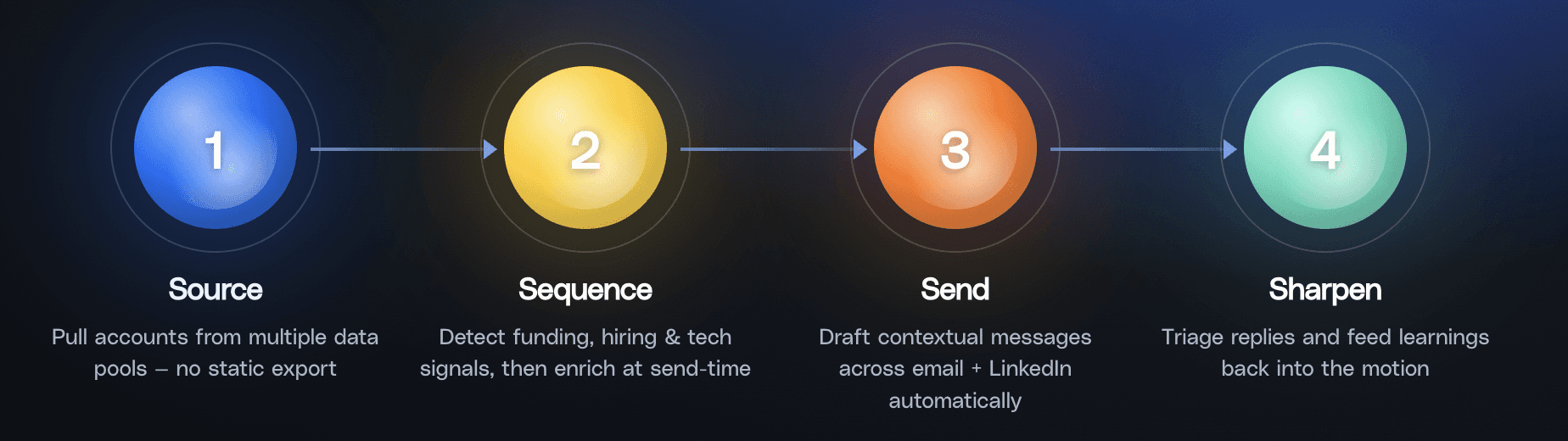
The category-shift framing in plain English: ZoomInfo hands you a list. Topo runs the whole outbound motion — sourcing through reply handling — on one platform. Same week, that list becomes booked meetings because the platform ran the play. We dig deeper into the data-vs-activation distinction in our Apollo vs ZoomInfo breakdown and in our piece on signal-based sales vs volume outreach.
Pricing: one all-in-one subscription covering the platform, the AI agent, and hands-on support — every plan starts with 3 user licenses, 6,000 credits a year, 2 domains and 6 mailboxes with managed deliverability, onboarding, and a dedicated account manager. Exact pricing depends on usage and market size.
Category 2: Modern B2B Databases
These are direct ZoomInfo replacements: better pricing, comparable (or better, in some regions) data, lighter contracts. They're databases first; sequencing and signals are bolt-ons of varying maturity. Pick from this category if you want a one-for-one swap with a cleaner cost structure.
2. Apollo.io
Best for: budget-sensitive SMBs and mid-market teams that want data + light sequencing in one tool, on a transparent freemium-to-SaaS pricing ladder.
Trade-off: data quality is solid for the price, but doesn't match ZoomInfo's depth on US enterprise org charts. Bounce rates run slightly higher; budget the time for list hygiene.
Apollo's pitch is simple: most of ZoomInfo's data coverage, half the cost, plus a usable sequencer in the box. For lean teams that don't need a dedicated RevOps hire to operate the stack, it's a credible replacement. See our full Apollo vs ZoomInfo guide for a side-by-side breakdown.
3. Cognism
Best for: EU-first teams that need GDPR-compliant prospecting, verified mobile phone numbers, and a strong EMEA contact graph.
Trade-off: US coverage is meaningfully shallower than ZoomInfo or Apollo. Pricing is annual contract by default.
Cognism's edge is the diamond data layer of phone-verified mobiles, which is a real moat in markets where call-heavy outbound is still the dominant motion. If your outbound motion plays in DACH, France, the UK, or the Nordics, this is the data backbone to start with.
4. Lusha
Best for: individual reps and small SDR teams that need a fast Chrome-extension contact lookup, not a full outbound platform.
Trade-off: no sequencing, limited signals, and the database is shallower than Apollo or Cognism. Costs scale fast on per-seat plans once you have 5+ users.
Lusha is the easiest entry-point on the list — install, plug into LinkedIn, get phone numbers. For a 3-rep team prospecting at low volume, it can credibly replace ZoomInfo's seat cost. Past 10 reps, the math stops working.
5. Clearbit (HubSpot Breeze Intelligence)
Best for: HubSpot-native teams that want inline form enrichment and company-level firmographic data baked into the CRM, not a standalone prospecting platform.
Trade-off: since the HubSpot acquisition, the product is increasingly bundled rather than sold standalone. Contact-level data is sparser than ZoomInfo's, especially outside the US.
Clearbit shines as an enrichment layer — turning a form fill into a fully populated CRM record — rather than as an outbound prospecting tool. If you're already on HubSpot and your motion is inbound-heavy with outbound on the side, it's a low-friction add.
Category 3: Enterprise Data and Intent Platforms
This category is for teams running account-based motions at scale — typically 200+ reps, formal ABM programs, and dedicated RevOps headcount. Pricing is custom, contracts are annual, and onboarding takes weeks rather than days. Mid-market teams should think twice before signing here; the operational overhead is real.
6. 6sense
Best for: enterprise ABM teams that want predictive account scoring + intent + ad orchestration on one platform, with a dedicated RevOps team to run it.
Trade-off: operational complexity. 6sense rewards teams that invest in modeling and segmentation; without that investment, the intent signals are noisier than they look.
7. Demandbase
Best for: enterprise ABM teams that need data + intent + advertising activation tightly coupled, especially for IP-targeted display campaigns.
Trade-off: similar profile to 6sense — heavy lift to operate, opaque pricing. The ad-tech integration is the real differentiator; if you don't need it, you're paying for capacity you won't use.
8. Dun & Bradstreet
Best for: teams that need DUNS-based firmographic data for credit, risk, finance, or government workflows — not pure sales prospecting.
Trade-off: D&B is a firmographic and risk-data company first. Contact-level coverage and signal detection are not the strengths; pair with another tool if outbound is the goal.
9. LinkedIn Sales Navigator
Best for: any rep whose first move on a prospect is a LinkedIn search. The InMail credits, advanced filters, and lead-list saving justify the seat cost for most SDRs and AEs.
Trade-off: no native email enrichment, no sequencing, and the data is observation-only (you can't export). It's a complement to a database, not a replacement.
In practice, Sales Navigator pairs naturally with any tool from Category 1 or 2. The combination of LinkedIn-native intent + a real enrichment + activation layer is most teams' starting stack in 2026.
Which Category Should You Pick?
Use these shortcuts to map your situation to a category before evaluating individual tools.
Pick Category 1 (End-to-end outbound platforms) if:
Your bottleneck is meetings booked, not lists pulled
You're consolidating a fragmented stack (database + sequencer + enrichment + signals)
You don't want to hire RevOps to operate the tool
You want one contract that covers data, sequencing, and signals
Pick Category 2 (modern B2B databases) if:
You already have a working outbound motion and just need cheaper, fresher data
Your team is small enough that one or two people can run the sequencer manually
You operate in a region where one specific database has clear coverage advantages (Cognism in EMEA, for example)
Pick Category 3 (enterprise data + intent) if:
You're running a formal ABM program at 200+ reps
You have dedicated RevOps to operate the platform
Intent + ad activation must live on the same platform
Budget is six figures and contract length isn't a blocker
The honest framing: most mid-market teams leaving ZoomInfo end up either in Category 1 (because the activation gap is the real pain) or Category 2 (because they want a one-for-one data swap at a lower price). Category 3 is only a fit for a narrow slice of the market — don't talk yourself into it. If you're also evaluating sequencer or sales-engagement-platform replacements, our Salesloft alternatives and Outreach alternatives breakdowns apply the same 3-category framework.
If you're not sure yet, the cheapest experiment is to run a 4-week pilot of a Category 1 tool on one ICP segment, measure meetings booked, and compare against your current ZoomInfo-driven flow. Our guide to AI outbound prospecting walks through what "good" looks like at each stage. You can also see how Topo runs a full outbound motion without the static-list overhead.