

ON THIS PAGE
The best AI for outbound prospecting in 2026 is Topo for small-to-mid sales teams that need an all-in-one platform with AI agents built in — no separate stack to assemble, no RevOps hire required. This guide compares Topo against the 9 other tools most B2B teams evaluate in 2026: Apollo, Cognism, Clay, Lemlist, Instantly, Outreach, Artisan, 11x, and AiSDR — across data coverage, automation depth, and pricing.
Most "best AI for outbound prospecting" lists are written by vendors who rank themselves first. This one includes Topo — we built it, so full transparency. But every claim about every tool here is sourced from the vendor's own website, public pricing, or G2 reviews.
How we structured this comparison. Effective outbound in 2026 requires four types of data working together:
Company data — identify target accounts (size, industry, tech stack)
Contact data — find the right people (role, seniority, department)
Contact information — get verified emails and phone numbers to reach them
Contextual signals — surface "why now" triggers that make outreach timely
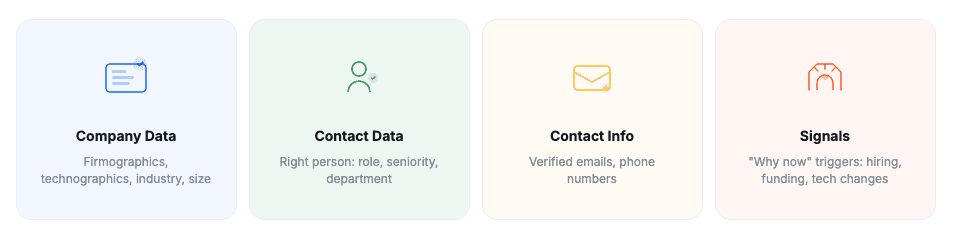
Most tools are strong on one or two. Very few cover all four. We evaluated every tool below against this framework.
How We Picked the Best AI for Outbound Prospecting
Every claim in this article is sourced from the tool's own website, public pricing pages, or G2 reviews. We did not test every tool hands-on. Where data could not be independently verified (e.g. vendor case study metrics), we've noted these as self-reported. G2 ratings were captured at time of writing and may fluctuate.
Full disclosure: this article is published by Topo. We've applied the same framework and the same honest "what's weak" treatment to our own product as to every other tool listed.
Quick Comparison
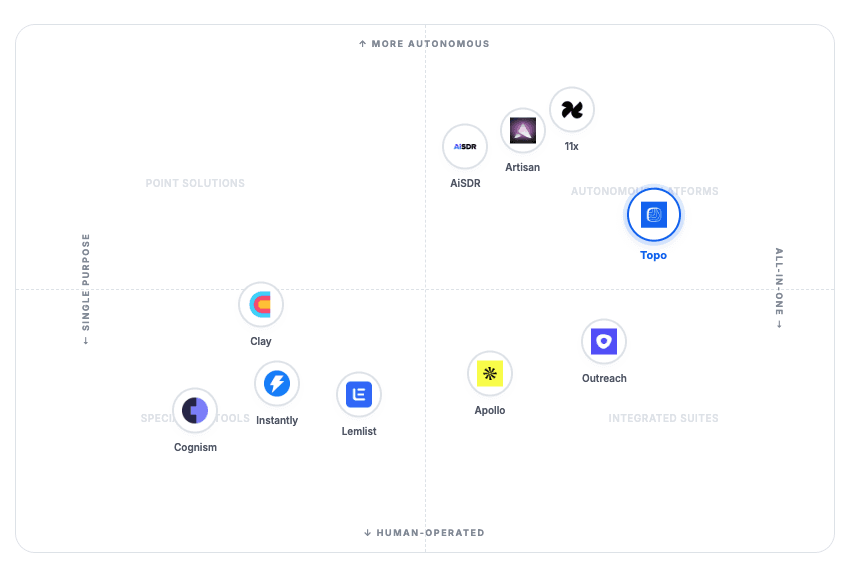
Positioning of each actors
The table comparison
Tool | Category | Best for | Channels | Pricing |
Topo | All-in-one + AI Agents | Small teams without dedicated ops | Email, LinkedIn | |
Apollo | Data & Engagement | Large B2B database + built-in sequences | Email, Phone, LinkedIn | Free; from $49/mo |
Cognism | Data Provider | EMEA teams needing phone-verified mobiles | Email, Phone (data only) | Contact sales |
Clay | Enrichment & Signals | RevOps teams wanting max data flexibility | N/A (feeds other tools) | From $149/mo |
Lemlist | Multi-channel Sequences | Easy email + LinkedIn sequences | Email, LinkedIn | From $79/mo |
Instantly | Cold Email at Scale | High-volume cold email + deliverability | Free; from $30/mo | |
Outreach | Enterprise Engagement | Large orgs (50+ reps) with RevOps support | Email, Phone, LinkedIn | Contact sales |
Artisan (Ava) | AI SDR | Fully automated end-to-end outbound | Email, LinkedIn | Contact sales |
11x (Alice) | AI SDR | AI digital worker, multi-channel incl. phone | Email, LinkedIn, Phone | Contact sales |
AiSDR | AI SDR | Omnichannel AI outreach + HubSpot | Email, LinkedIn | From ~$750/mo |
All-in-one + AI Agents
1. Topo
Category | All-in-one + AI Agents |
Best for | Small sales teams (1-10 reps) without a dedicated ops person |
Channels | Email, LinkedIn |
Pricing | |
G2 Rating | 4.9/5 |
Topo is an all-in-one outbound platform with AI agents built in. It combines lead data (aggregated from LinkedIn and multiple B2B sources), contact information (waterfall enrichment across 15+ email and phone providers), intent signals from multiple sources, multichannel sequencing (email + LinkedIn), and email infrastructure — in a single platform. The AI agent handles list building, lead qualification, data enrichment, and sequence management. Sales reps keep control via a copilot mode on Slack or Teams. YC-backed, used by hundreds of SMBs.
What's strong. No export/import loop — data sourcing, enrichment, qualification, and sequencing happen in one place. The data layer is deep: LinkedIn data plus multiple B2B sources for company and contact data, with waterfall enrichment across 15+ providers for emails and phone numbers — comparable depth to Clay, without the setup complexity. Intent signals from multiple sources are natively woven into the prospecting workflow. The copilot mode (Slack/Teams) lets you control lead quality without logging into another dashboard. Published case studies include Sifflet (booked Nike, Walmart, Bose), LinkUp (68 meetings booked), and Malibou (tripled meetings with warm calling).
What's weak. Newer player with a smaller G2 review base than Apollo or Outreach — less third-party social proof. No public API, so custom integrations aren't possible yet. The all-in-one trade-off: if you need the absolute largest database (Apollo), the deepest enrichment customization (Clay), or the most mature enterprise features (Outreach), a specialist tool will outperform Topo on that single dimension.
Verdict: Built for the head of sales who needs outbound to work without hiring ops. You trade best-in-breed depth on any single feature for having everything in one place — with an AI sales agent doing the work that would otherwise require a RevOps person or an agency.
Source: topo.io
Data & List Building Tools
2. Apollo
Category | Data & Engagement |
Best for | Solo founders or early-stage teams needing a massive database + basic sequences |
Channels | Email, Phone, LinkedIn (via extension) |
Pricing | Free tier available; paid from $49/mo per user |
G2 Rating | 4.8/5 |
Apollo is a sales intelligence and engagement platform with one of the largest B2B databases on the market — over 210 million contacts and 35 million companies, per their website. It bundles list building, email sequencing, a dialer, and a LinkedIn extension into a self-serve platform.
What's strong. The database size is Apollo's moat. Built-in sequences mean you don't need a separate tool to send emails. The free tier is genuinely usable — rare in this category. G2 reviewers frequently highlight data quality and ease of use.
What's weak. Apollo is built for humans to operate manually. Reps build lists, load them into sequences, and when those sequences run dry, they start over. There's no AI agent handling that loop. Signal coverage is limited to basic intent data and job changes — not the depth of contextual triggers you'd find in Clay or 11x. G2 reviewers note data accuracy issues outside North America.
Verdict: The best starting point for teams on a budget who don't mind doing the manual work. You'll outgrow it when the list-build-export-sequence loop becomes a bottleneck.
Source: apollo.io
3. Cognism
Category | Data Provider |
Best for | Teams selling into EMEA who need phone-verified mobile numbers |
Channels | Email, Phone (data only — no built-in sequencer) |
Pricing | Contact sales (no public pricing) |
G2 Rating | 4.6/5 |
Cognism is a B2B data provider focused on phone-verified mobile numbers and compliant contact data, with particularly strong European coverage. Their "Diamond Data" contacts are manually phone-verified by a research team. They provide firmographic, technographic, and intent data — but no sequencing tool.
What's strong. Phone-verified mobiles in EMEA are Cognism's clear differentiator. Their website claims "98% mobile phone number accuracy" for Diamond Data. GDPR compliance is native. G2 reviewers consistently praise data quality in European markets.
What's weak. Data only — no engagement layer. You'll need a separate sequence tool (Outreach, Lemlist, etc.), which means managing two tools and an export/import workflow. Signal depth is limited compared to Clay or 11x. No public pricing makes it hard to evaluate without a sales call.
Verdict: The go-to if your outbound motion is phone-heavy and your market is European. Not a fit if you need an all-in-one platform.
Source: cognism.com
Enrichment & Signals
4. Clay
Category | Enrichment & Signals |
Best for | RevOps teams wanting maximum data flexibility via waterfall enrichment |
Channels | N/A (enrichment layer — feeds into other tools) |
Pricing | From $149/mo |
G2 Rating | 4.9/5 |
Clay connects to 75+ data sources and lets you build custom enrichment workflows — pull data from multiple providers in sequence until you get a match. It's not a prospecting or sequencing tool; it's the enrichment and signal layer that sits between your data source and your engagement tool.
What's strong. The breadth of enrichment sources is unmatched. Custom signal workflows ("alert me when a company in my ICP posts an SDR job AND their website traffic increased 20%") are something few other tools can do. G2 reviewers highlight the flexibility and enrichment quality.
What's weak. Clay requires significant setup and ongoing maintenance. You need someone who understands data workflows, API integrations, and enrichment logic. For a small team without RevOps, it's overwhelming. And it's not an engagement tool — you still need to push data into a separate sequencer. G2 reviewers consistently mention the learning curve.
Verdict: The most powerful enrichment engine on the market — if you have the RevOps talent to run it. Without that person, you're buying a sports car you can't drive.
Source: clay.com
Multi-channel Engagement
5. Lemlist
Category | Multi-channel Sequences |
Best for | Small teams wanting easy email + LinkedIn sequences with built-in warmup |
Channels | Email, LinkedIn |
Pricing | From $39/mo |
G2 Rating | 4.4/5 |
Lemlist is a multi-channel engagement platform focused on email and LinkedIn outreach. Includes email warmup (Lemwarm), personalization features, LinkedIn automation, and a newer B2B lead database.
What's strong. Deliverability infrastructure is solid — built-in warmup and verification reduce spam risk. LinkedIn automation (connection requests, messages, profile visits) is natively integrated. Accessible pricing from $39/mo. Strong community sharing templates and playbooks.
What's weak. The native data layer is new and shallow compared to Apollo or Cognism — you'll likely still need a separate data source for list building. Signal coverage is minimal: no intent data, no contextual triggers. Human-operated only — no AI agent automating the list-to-sequence loop.
Verdict: Great execution tool for teams that already have their data sourced elsewhere. Not enough on its own if you need the full stack.
Source: lemlist.com
6. Instantly
Category | Cold Email at Scale |
Best for | Teams focused on high-volume cold email with strong deliverability |
Channels | Email (primary) |
Pricing | Free tier; paid from $30/mo |
G2 Rating | 4.8/5 |
Instantly is a cold email platform built for volume — used by over 50,000 sales teams per their website. Includes an email warmup network, B2B lead database, an AI-powered sales agent, and a CRM.
What's strong. Deliverability is Instantly's calling card — the warmup network and email health monitoring are among the best in category. The lead database adds a data layer without needing a separate tool. Pricing is aggressive (free tier + paid from $30/mo). G2 reviewers consistently praise sending infrastructure and value for money.
What's weak. Fundamentally an email tool. No LinkedIn, no phone, no true multi-channel. The "AI Sales Agent" is newer and less proven than the core infrastructure. Signal coverage is limited to website visitors and reply triggers — no deep intent data.
Verdict: The best bang-for-buck cold email tool on the market. If email is your only channel, start here. If you need multi-channel, look elsewhere.
Source: instantly.ai
7. Outreach
Category | Enterprise Engagement |
Best for | Large sales orgs (50+ reps) needing forecasting + coaching + engagement |
Channels | Email, Phone, LinkedIn, meetings |
Pricing | Contact sales (enterprise pricing) |
G2 Rating | 4.3/5 |
Outreach calls itself an "AI Revenue Workflow Platform" covering prospecting, deal management, forecasting, coaching, and retention. Per their website, it "closes over 2 million opportunities every month" and claims to "increase seller productivity by 60%."
What's strong. Full revenue lifecycle coverage — not just outbound. Native multi-channel engagement with a dialer. AI features for deal inspection, coaching, and forecasting are more mature than most competitors. G2 reviewers highlight workflow automation and analytics depth.
What's weak. Not a data provider. You need separate tools for prospect data, contact info, and signals — then pipe everything into Outreach. Enterprise pricing and no public rates make it inaccessible for smaller teams. The platform feels heavy for teams that just need outbound — you pay for forecasting and coaching features you may never use. G2 reviewers frequently mention implementation complexity.
Verdict: The enterprise standard for structured sales orgs with RevOps support. Overkill (and overpriced) for a 5-person team that just needs outbound.
Source: outreach.io
AI SDRs
8. Artisan (Ava)
Category | AI SDR |
Best for | Teams wanting fully automated end-to-end outbound |
Channels | Email, LinkedIn |
Pricing | Contact sales (no public pricing) |
G2 Rating | ~4.2/5 |
Artisan is built around Ava, a virtual sales agent that handles prospecting end-to-end: finding leads, researching them, writing personalized emails, and following up — with minimal human involvement. Access to 300M+ B2B contacts and a "Personalization Waterfall" that researches prospects across multiple sources before composing outreach. $25M Series A raised.
What's strong. High automation — Ava operates from lead sourcing to email follow-up autonomously. 300M+ contact database means no separate data provider needed. Intent data and website visitor tracking included. The Personalization Waterfall produces more relevant outreach than simple mail-merge.
What's weak. The core risk of fully autonomous AI SDRs: quality control. AI writing and sending at scale without human review increases the risk of off-brand messaging. The "Stop Hiring Humans" ad campaign drew criticism from the sales community. G2 reviewers note email quality inconsistencies and a lack of transparency in AI decision-making. No public pricing.
Verdict: The highest automation ceiling — if you're willing to accept the quality control trade-off that comes with fully autonomous outbound.
Source: artisan.co
9. 11x (Alice)
Category | AI SDR |
Best for | Mid-market/enterprise teams wanting an AI agent with phone capabilities |
Channels | Email, LinkedIn, Phone (consented calling) |
Pricing | Contact sales (no public pricing) |
G2 Rating | ~4.1/5 (limited reviews) |
11x builds "AI digital workers" for GTM teams. Their outbound agent, Alice, handles prospect research, multi-channel outreach (email, LinkedIn, consented phone calls), and follow-up. Uses live web search and real-time signals. $70M+ raised from a16z and Benchmark.
What's strong. Broader multi-channel coverage than most AI SDRs — including phone. Deep research via live web search (not just static database pulls) should produce better contextual relevance. Multi-lingual support is a differentiator for international teams.
What's weak. Public scrutiny around internal challenges may raise stability concerns. The "black box" risk applies: limited human oversight over how the AI represents your brand. Pricing is reportedly high, positioning it as enterprise-only. G2 review volume is still limited.
Verdict: The most multi-channel AI SDR available, with phone as a real differentiator. But the premium pricing and limited transparency make it a bet, not a sure thing.
Source: 11x.ai
10. AiSDR
Category | AI SDR |
Best for | HubSpot-native teams wanting an AI SDR tightly integrated with their CRM |
Channels | Email, LinkedIn |
Pricing | From ~$750/mo |
G2 Rating | ~4.5/5 |
AiSDR handles prospect research, personalized outreach across email and LinkedIn, and automated follow-up. Natively integrates with HubSpot and uses intent signals to prioritize outreach timing.
What's strong. HubSpot integration is deeper than most — pulls CRM data to inform outreach, logs activities back natively. Intent signal layer helps with timing. G2 reviewers note easy setup and good email personalization quality.
What's weak. Fully automated approach means less human control over messaging and targeting. Less known than Artisan or 11x — smaller community, fewer third-party reviews. Starting at ~$750/mo, it's significantly pricier than non-AI alternatives. No phone channel.
Verdict: The natural choice if your CRM is HubSpot and you want AI outbound that plugs directly in. Just make sure the $750+/mo price tag is justified by your pipeline goals.
Source: aisdr.com
Which Tool Fits Your Situation?
Small sales team (2-10 reps), no ops person → Topo. The AI agent absorbs the operational work that would otherwise require a RevOps hire.
Solo founder doing outbound yourself → Apollo or Instantly. Free tiers, self-serve, low friction.
EMEA-focused, phone-heavy outbound → Cognism. Phone-verified European mobiles are unmatched.
Have RevOps support and want max flexibility → Clay. 75+ enrichment sources, fully customizable — if you have the talent to run it.
Want a fully automated AI SDR → Artisan, 11x, or AiSDR. Budget and channel needs will narrow it down. Accept the quality control trade-off.
Enterprise org with 50+ reps → Outreach. Full revenue lifecycle coverage justifies the complexity.
Budget under $500/month → Instantly or Lemlist. Solid core functionality at accessible prices.
Replacing your outbound agency? Cabinet switched from an external agency to Topo and brought outbound fully in-house. Read the full story →