

ON THIS PAGE
Your prospects have probably already told you how to sell to them. It happened on a discovery call, and the recording sits in a folder nobody opens.
Imagine you send 400 emails and six people reply. The other 394 never tell you whether the subject line was off or the pain simply didn't exist for them. Put a buyer with the same profile on a call and they'll often say, in their own words, what they care about and what bores them, and you can reuse that sentence in your next email.
So this guide rates sales call recording software on one question: how easily does each tool turn your calls into material for your next outbound campaign? We compare 7 tools on recording, AI analysis, CRM sync, API and MCP access, and pricing.
Topo doesn't sell a call recorder, so it isn't ranked here. The order follows the buying criteria below. Every product claim comes from the vendor's own website, checked on October 23, 2026, and we say so when something isn't published.
What our own calls taught us about outbound copy
Different buyers buy the same product for different reasons, and they only tell you which reason on a call. Two findings from our calls at Topo show what that looks like.
Software companies wanted their reps' time back
Software companies reacted strongly when we talked about a CRM that updates itself at closing. Their reps had no time left to do it, and the pipeline was going blind as a result. That's a business case you can open an email with, and it belongs to one segment; other segments in the same week of calls cared about something else entirely.
Once you see a pattern like this in five or six calls, you've got a hypothesis worth a dedicated campaign.
Buyers understood "AI fields" faster than "CRM"
Vendors describe their product with their own internal words, and those words often fall flat. "CRM" on its own, as a keyword in our pitch, didn't land: everybody has a CRM, so the word carries no promise. "Auto-update" was vague too. When we said "AI fields" (fields in your CRM that AI fills in for you), people got it immediately.
You'll never find that in an open-rate report, and it changes how every email in a sequence reads.
Put the two together and you have a campaign brief
A business case for one segment, written in the buyers' own words, gives you a target audience and the argument that works on it. Add what you picked up on the calls, such as the tools they use, the trigger that made them take the meeting and the objection they raised first. That's enough to build a segmented list and write a sequence that sounds like it comes from someone who has spoken to their peers, because it does.
Then the loop starts. New campaigns bring new meetings, and the calls from those meetings tell you whether the message held up or needs adjusting; run it every week and each batch of calls checks your copy again.
Done by hand, that means someone listening to hours of recordings and taking notes. So the tool you pick matters, and so does how easily its data gets out of it and into the place where you write campaigns.
How to choose sales call recording software for outbound
A call recorder sends a bot into Zoom, Google Meet or Microsoft Teams, or plugs into your phone system, and produces a transcript. That part is close to a commodity now: most tools transcribe in dozens of languages and several have free plans. The usual buying criteria, from transcription accuracy to forecasting, still apply. For outbound, the differences start once the transcript exists, so check these six.
Search across all calls. Can you ask "what did fintech prospects say about pricing this quarter?" and get an answer with the calls behind it? Chat with a single call is common. Reliable multi-call search is rarer, and several vendors keep it for higher tiers. Vendors call this cross-call layer conversation intelligence software: it tracks objections, competitor mentions, churn signals or feature requests across hundreds of conversations, so you spot the pattern that shows up in 30 calls.
Structured extraction. You want objections, pains, competitor mentions and use cases pulled out the same way on every call, because free-text summaries are hard to aggregate and you need to compare segments. On a single call, most tools also give you a summary, next steps and a score against your sales method (MEDDIC, BANT, SPICED and so on).
CRM sync. Insights should land in the right fields on the contact, company and deal. That's what later lets you build an outbound audience from "accounts that raised objection X".
API and MCP access. An MCP server lets other tools query your calls directly: an AI assistant like Claude, ChatGPT or Copilot, or an outbound platform such as Topo. For outbound this matters most, because your call data has to leave the recorder and reach the place where you build campaigns. Check whether the server returns raw transcripts, structured fields or only summaries, and whether it writes as well as reads. A tool that keeps every insight in its own dashboard still works for coaching, but your outbound team will end up copying verbatims out by hand.
Languages and hosting. If you sell in Europe, check transcription quality in your languages and on calls that switch language mid-way, and find out where the vendor stores recordings.
Pricing model. Per seat, platform fee, minimum seats, and which features sit in which tier. Multi-call AI search and CRM field sync are often the paid upgrades.
Sales call recording software comparison
Tool | Best for | What it extracts | CRM integrations | API / MCP | Starting price |
|---|---|---|---|---|---|
Praiz | Teams that want the same fields extracted from every call | AI agents track objections, competitors and deal risks on every call | HubSpot, Salesforce, Pipedrive, Attio, Dynamics 365, Zoho | MCP server (read and write, according to Praiz) | €35/user/month billed annually (3-user minimum) |
Gong | Large revenue orgs wanting a full revenue platform | Deal and account insights, trackers, forecasting | Salesforce, HubSpot, MS Dynamics (native) | MCP server (read-only, summarized insights) | On request (per Gong: per-user license + platform fee) |
Modjo | French and European sales teams | AI agents, AI insights, signal detection | Salesforce, HubSpot (others on request) | MCP and open API | On request |
Avoma | Teams that also want scheduling and lead routing | Conversation intelligence add-on, "Ask Avoma" across calls | Salesforce, HubSpot, Zoho, Pipedrive, Copper | API and webhooks (Organization plan); MCP listed | $19/recorder seat/month billed annually + add-ons |
Fathom | Small teams starting with a free plan | Trackers (objections, competitors), account-wide Ask Fathom (beta) | HubSpot, Salesforce | Public API and MCP | Free plan; paid from $15/user/month billed annually (Team, 2-user minimum) |
Fireflies | Budget-conscious teams wanting API access early | AskFred, conversation intelligence (Business) | Salesforce, HubSpot and others | API and MCP on all plans | Free; Pro $10/seat/month billed annually |
tl;dv | EU teams wanting multi-meeting AI reports | Multi-meeting Ask AI, scheduled AI reports, AI objection handling (Business) | CRM integrations from Pro | MCP, API and webhooks from Pro | Free; Pro $18/seat/month billed annually |
Source: vendor websites, checked October 23, 2026. Prices exclude tax where the vendor says so.
The 7 best sales call recording tools for outbound teams
1. Praiz
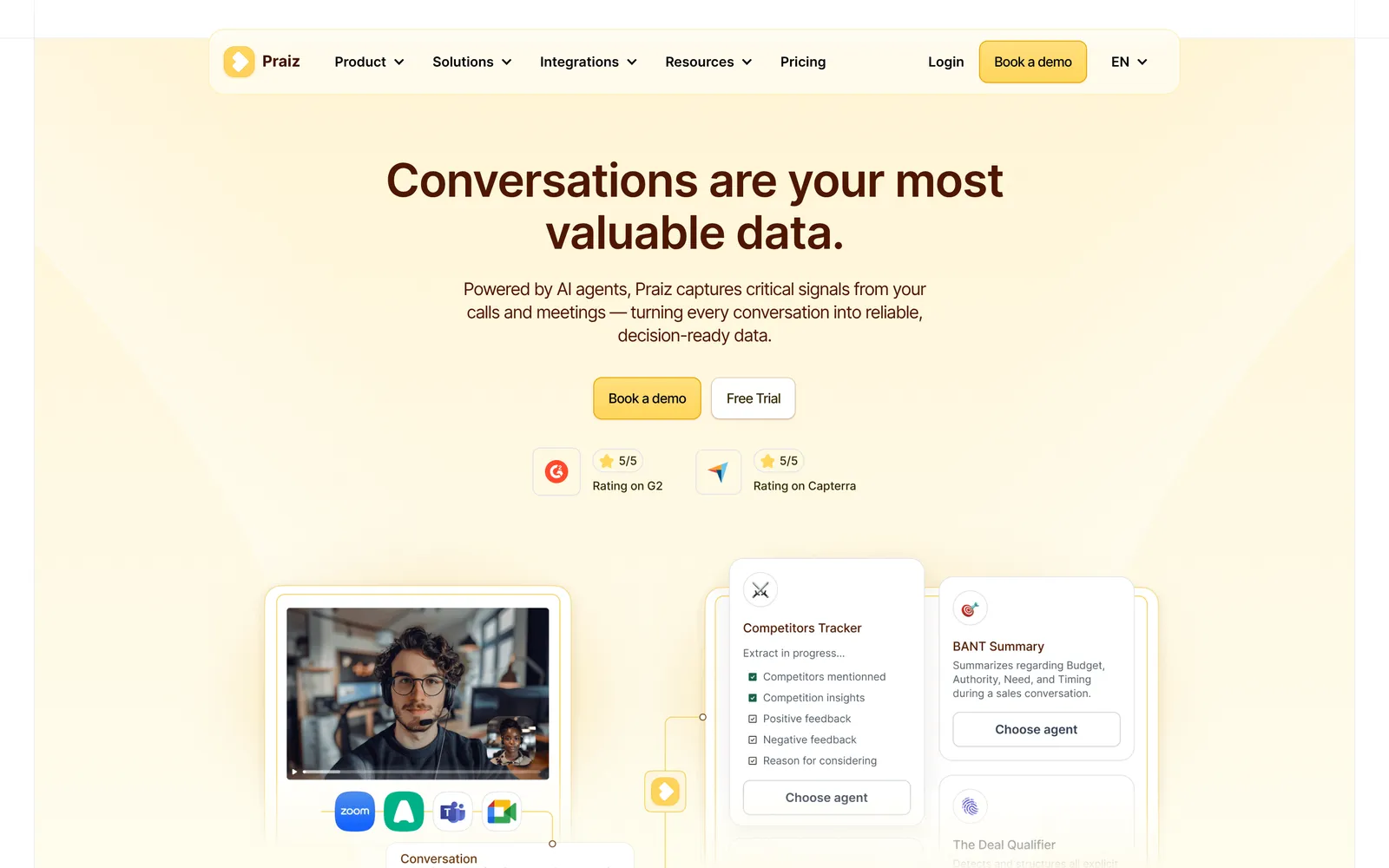
Praiz runs AI agents on every call and meeting (source: praiz.io)
Praiz runs AI agents on every meeting and call. They fill your CRM, score each call against your team's sales method and track objections, competitor mentions and deal risks. Praiz records Zoom, Meet and Teams, phone calls through Aircall, Ringover and Minari, and in-person meetings from a mobile app. CRM sync covers HubSpot, Salesforce, Pipedrive, Attio, Dynamics 365 and Zoho.
Other tools reach that call data through the Praiz MCP server, which reads and writes, according to Praiz.
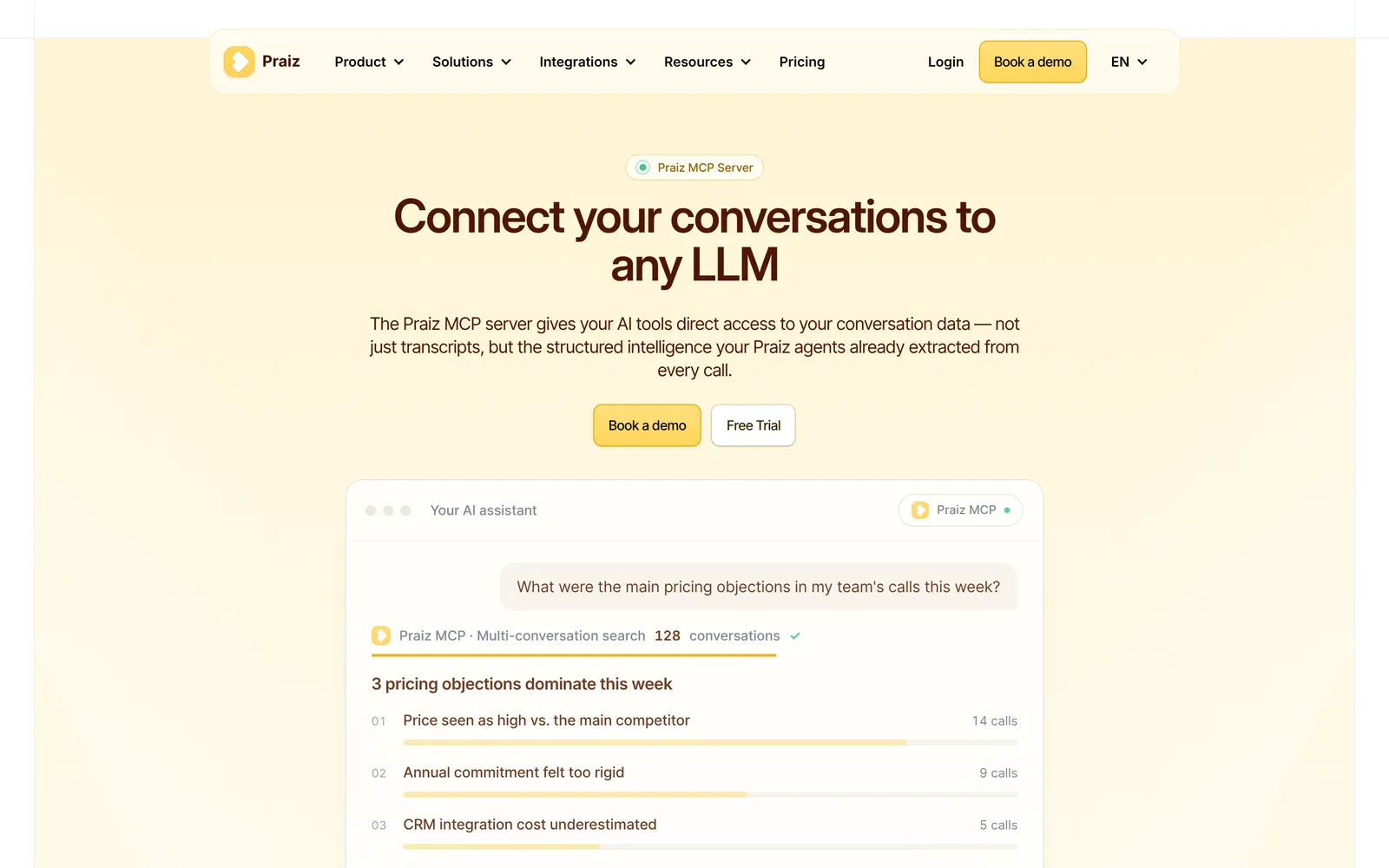
An AI assistant querying 128 calls through the Praiz MCP server (source: praiz.io)
Pricing. €35 per user per month billed yearly (€40 billed monthly on an annual contract), with a 3-user minimum and a 7-day free trial.
Watch-outs. There's no free plan, and the 3-user minimum rules out solo reps. Praiz notes that accuracy drops when speakers switch languages mid-call, and we found no GDPR, SOC 2 or ISO certification on its public pages.
2. Gong
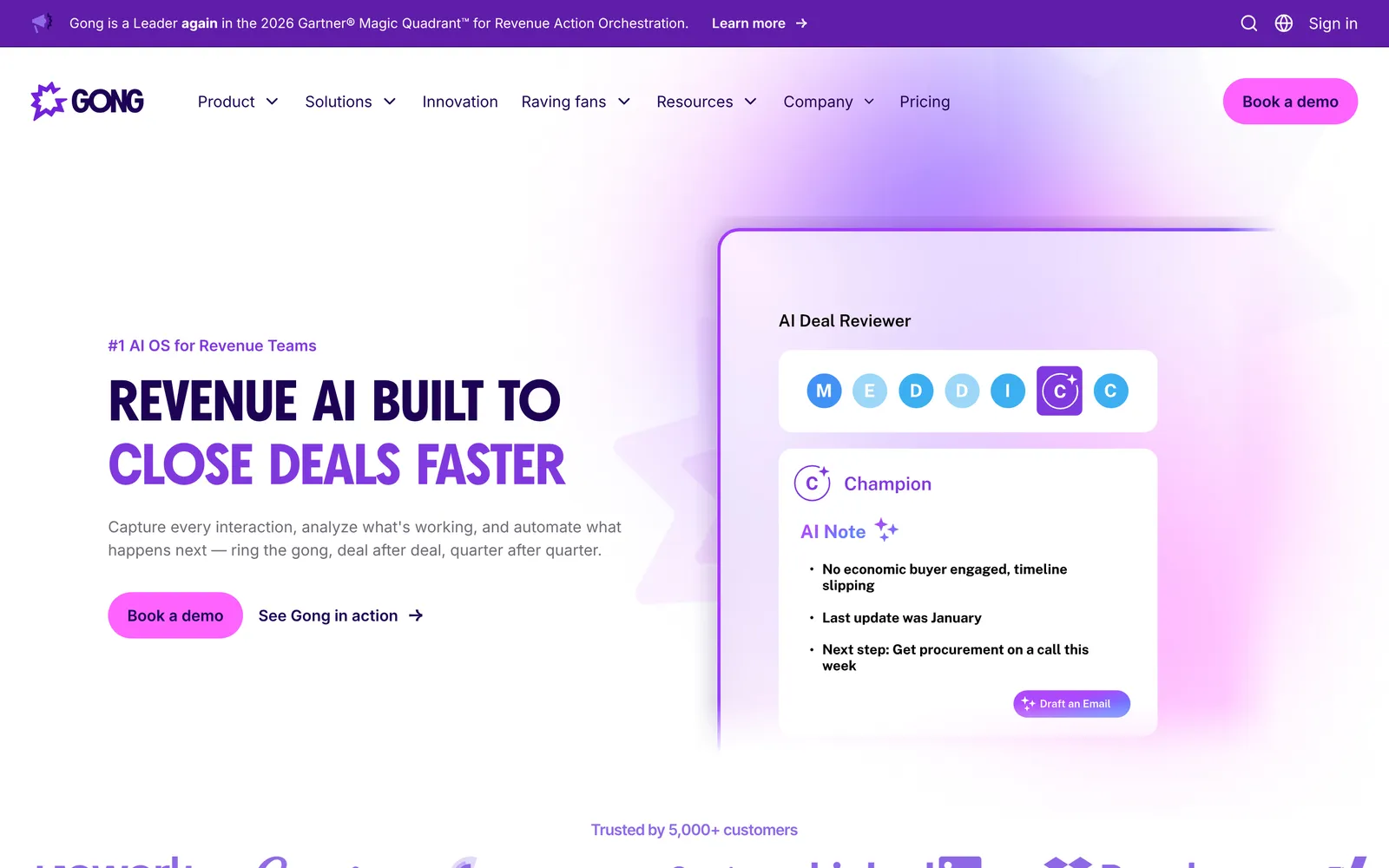
Gong's AI Deal Reviewer (source: gong.io)
Gong is the best-known name in the category. It now calls itself a "Revenue AI OS" and bundles recording and analysis with Gong Engage, Gong Forecast, Gong Enable and Gong Agents, and it claims 5,000+ customers.
Its MCP server, documented in the Gong Help Center since May 2026, offers three tools (ask_account, ask_deal, generate_brief). Gong says it's read-only and returns summarized insights, which suits account briefs and deal prep from an AI assistant. Native CRM integrations cover Salesforce, HubSpot and MS Dynamics. Pricing isn't public: Gong's pricing page describes a per-user license plus a platform fee, quoted after a form.
Best for. Larger revenue teams ready to put most of their sales stack with one vendor.
Watch-outs. The platform fee weighs more on a small team. And because the MCP server doesn't return raw transcripts, you have to open the Gong app to get a prospect's exact wording.
3. Modjo
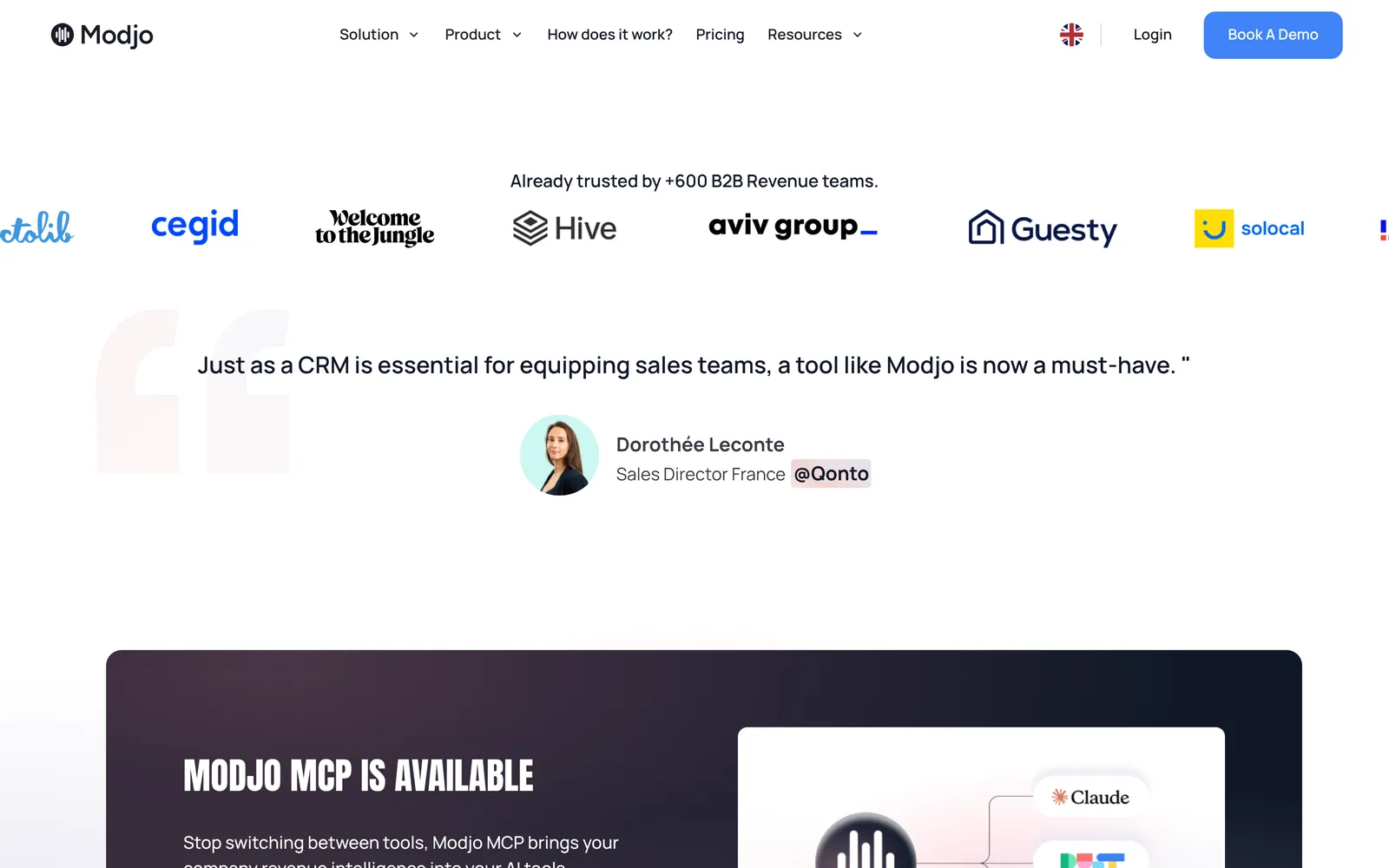
Modjo announces its MCP on its home page (source: modjo.ai)
Modjo is a French revenue intelligence platform that says it's trusted by 600+ B2B revenue teams. Its AI agents transcribe calls, fill CRM objects and fields (custom ones included) and flag signals such as churn risk, expansion opportunities and competitor moves. It offers an MCP server and an open API, and transcribes 100+ languages.
Modjo is explicit about hosting: AWS in the Paris region, with SOC 2 Type II and GDPR compliance listed. Salesforce and HubSpot are the named CRM integrations, and the demo form also lists Dynamics 365, Pipedrive, Sellsy and Zoho. Pricing is on request; Modjo says it's "optimal from 3 sales reps" and runs a 30-day onboarding with an account manager.
It fits French and European teams that want a local vendor with clear EU hosting and someone to guide the rollout. You'll talk to sales before you see a number, though.
4. Avoma
Avoma sells meeting recording as a base plan and stacks scheduling, lead routing, conversation intelligence and revenue intelligence on top.
A recorder seat costs $19 per month billed annually on Startup, $29 on Organization and $39 on Enterprise (10-seat minimum); viewers are free. Two add-ons cost $29 per seat each, billed annually: Conversation Intelligence brings call scoring and a global "Ask Avoma" across calls, and Revenue Intelligence brings deal risk alerts and two-way CRM field updates.
CRM integrations include Salesforce, HubSpot, Zoho, Pipedrive and Copper. API and webhooks come with Organization, and Avoma lists an MCP offering without naming the plan. It transcribes 70+ languages and lists SOC 2 compliance.
Best for. Mid-size teams that also want scheduling and lead routing in the same tool.
Watch-outs. Call scoring, cross-call search and CRM field updates sit in the two add-ons, so a Startup seat set up for this use case comes to about $77 per month billed annually.
5. Fathom
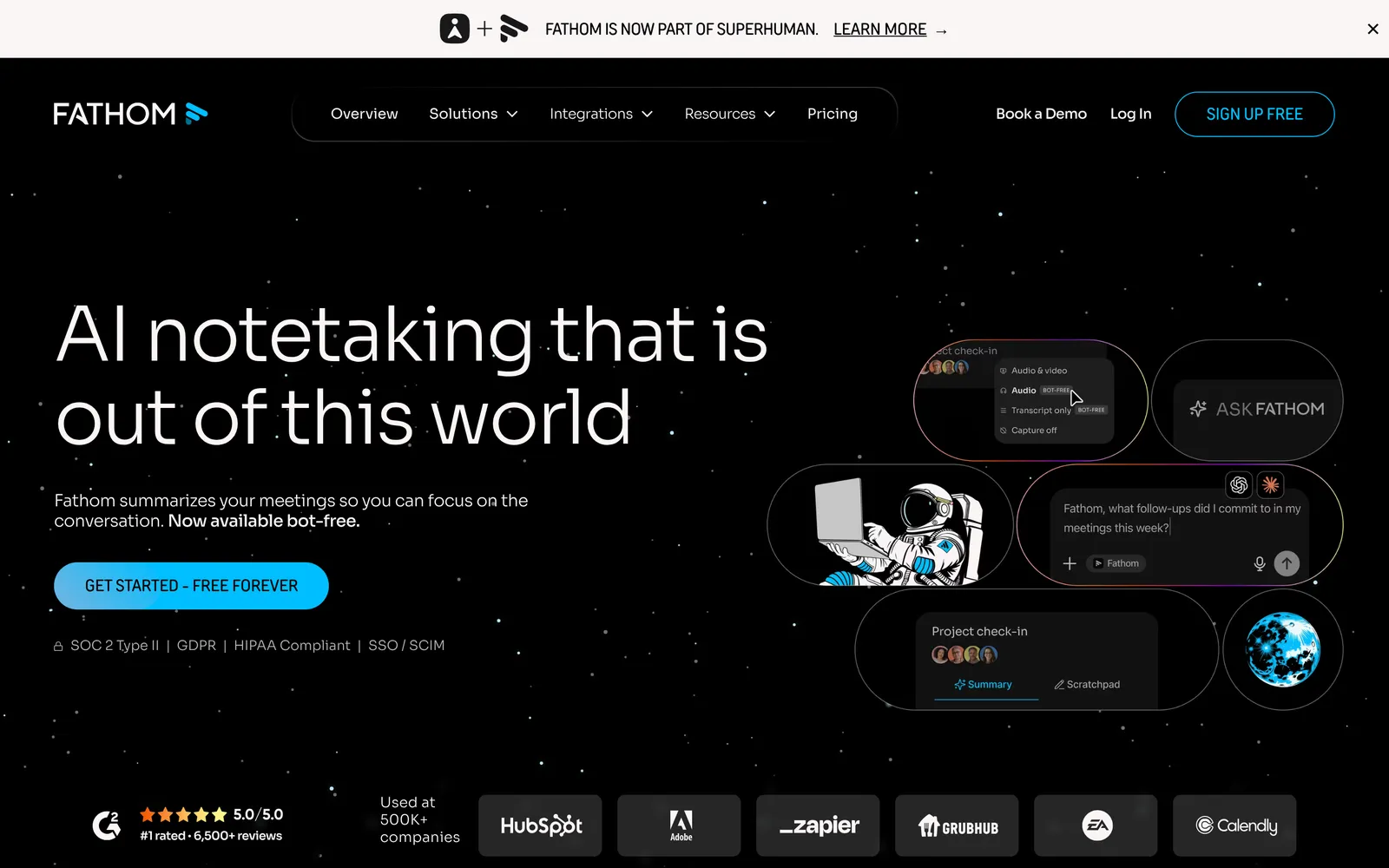
Fathom's meeting assistant (source: fathom.ai)
Fathom grew on a free plan with unlimited recordings and transcription, and it's still one of the easiest tools to start with. The sales features are paid: trackers that tag competitor mentions, objections and feature requests, a Deal View, and CRM field sync on Business. Fathom lists a public API and MCP, plus Claude and ChatGPT integrations.
Pricing. Free forever. Premium, for individuals, costs $16 per user per month billed annually ($20 monthly). Team costs $15 billed annually ($19 monthly) and Business $25 ($34 monthly), both with a 2-user minimum. Enterprise goes through sales.
Best for. Small teams that want a solid free start and plan to upgrade once they need CRM field sync and trackers.
Watch-outs. Multi-call analysis is still maturing: account-wide Ask Fathom is in beta, with limited use on some tiers.
6. Fireflies
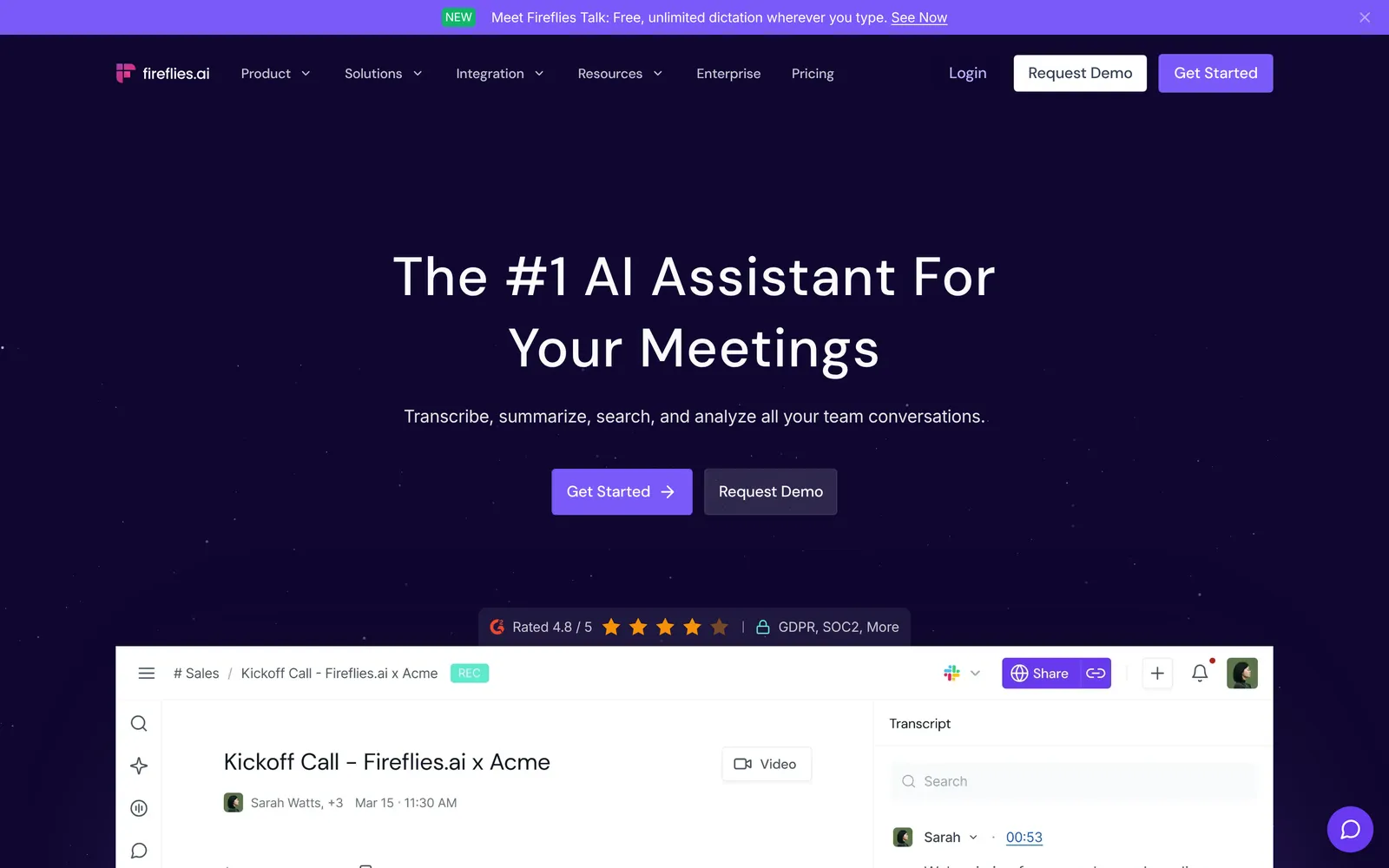
Fireflies transcript view (source: fireflies.ai)
Fireflies is one of the most open tools here. The API comes with every plan, free included, and so does the official MCP server announced in August 2026. It searches meetings by keyword, date or participant and returns full transcripts with speakers and timestamps, which is exactly what you need to get raw verbatims into another tool.
Fireflies transcribes 100+ languages and lists SOC 2 Type II, ISO 42001 and GDPR compliance. Its integrations page names Salesforce and HubSpot among CRMs, and Aircall, RingCentral, Zoom Phone and OpenPhone for phone calls.
Pricing. There's a free plan; billed annually, Pro starts at $10 per seat per month, Business at $19 and Enterprise at $39.
That makes Fireflies the cheap way to get full transcripts out early. Conversation intelligence and team analytics start on Business, though, so on lower plans you'll do most of the analysis in another tool.
7. tl;dv
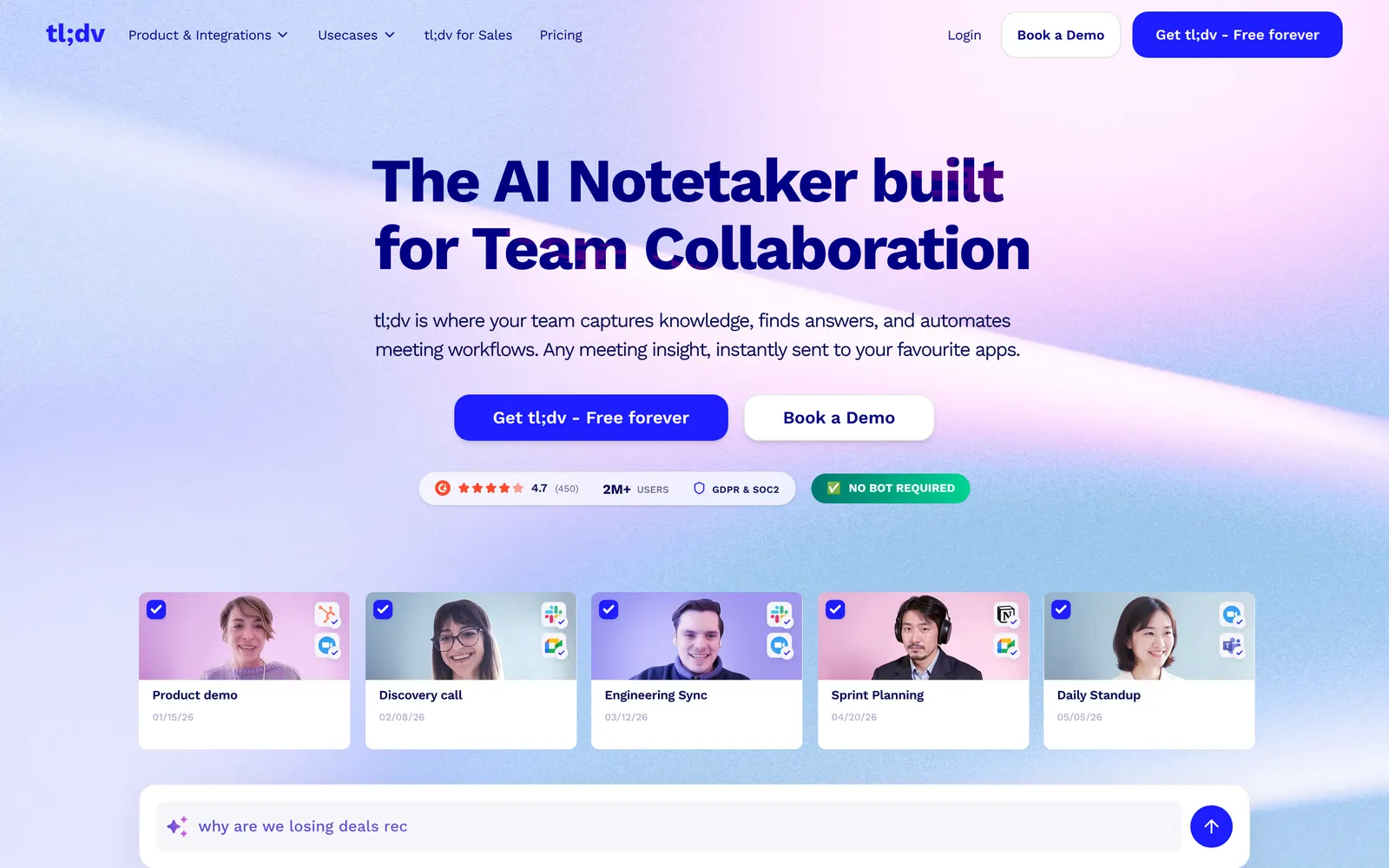
tl;dv lets you ask questions across meetings (source: tldv.io)
tl;dv started as a meeting recorder for team collaboration and has added sales features since. Pro already includes global transcript search, CRM integrations, the MCP server, API and webhooks. The part that matters for outbound sits on Business: unlimited multi-meeting AI insights, scheduled AI reports and AI objection handling. tl;dv states it's GDPR and SOC 2 compliant and "hosted and stored in EU".
Pricing. Free to start, then $18 per seat per month for Pro and $29 for Business, both billed annually; Enterprise is custom.
European teams that want recurring AI reports across meetings, without a sales-led buying process, will find it easy to try. Check the language list first: tl;dv transcribes 30+ languages, fewer than most tools here.
From calls to campaigns every week, with Topo
Once you're recording calls, the job is getting what buyers said to whoever writes your outbound, without anyone replaying recordings by hand.
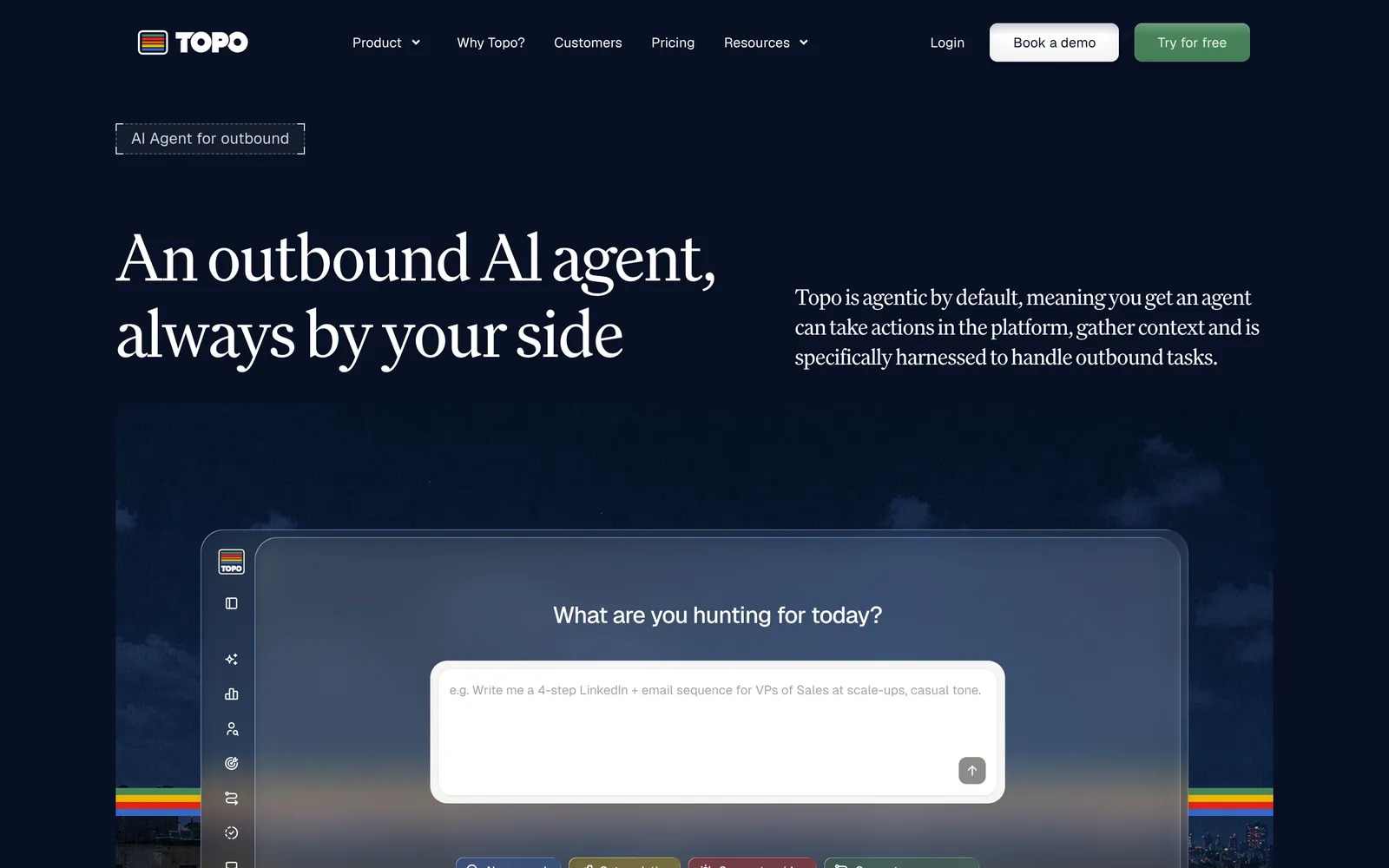
Topo's outbound AI agent (source: topo.io)
Topo is an all-in-one AI sales platform for outbound, with AI agents working by your side. The loop below works with any recorder that has an MCP server; Modjo, Fathom, Fireflies and tl;dv all list one. Gong's MCP server returns only summaries, so you'd get the gist of each call without the buyer's wording.
1. Connect your call recorder to Topo with MCP. Topo's AI sales agent then reads your calls the same way it reads your CRM.
2. Schedule a weekly task in Topo. Every Monday it pulls last week's calls, saves the most telling verbatims into Topo's memory and proposes campaign ideas: an audience, and the argument that worked on it in the prospects' own words.
3. Approve and launch. Reps pick an idea and check the leads and messages Topo's agents draft. Once approved, the campaign runs as a Topo sequence, and the meetings it books become next week's calls.
Want to see it on your own calls? Start a free Topo trial.
Which one should you pick?
You want AI agents that run on every call and turn what buyers say into structured data.Praiz fills the CRM, scores each conversation against your sales method and tracks objections, competitors and deal risks; you can query that data or pipe it into other tools through MCP.
You run a large revenue org and want recording and forecasting from one vendor.Gong does both and adds engagement on top; budget for the platform fee its pricing page describes.
You'd rather buy from a French vendor and have someone guide the rollout. Shortlist Modjo, which hosts on AWS in the Paris region and runs a 30-day onboarding with an account manager.
You want raw transcripts in another tool on a small budget.Fireflies includes API and MCP on every plan, free included, and returns full transcripts.
You also need scheduling and lead routing.Avoma covers both, with conversation intelligence as an add-on.
You're a small team watching every euro.Fathom and tl;dv both have usable free plans; tl;dv says it hosts data in the EU, and its Business plan adds multi-meeting reports.
Before you sign, test each tool on one real question: "What did prospects in segment X object to last month, in their own words?" If it can't answer within a few minutes, it won't help much with outbound.