

ON THIS PAGE
SDR vs BDR: The Real Difference (And Why AI Changes the Game)
SDR vs BDR: The 30-Second Answer
Let's be honest, the sales world loves its acronyms — and the SDR vs BDR debate is one of the most common mix-ups. Sales Development Reps (SDRs) and Business Development Reps (BDRs) sound interchangeable, but they serve fundamentally different functions in your revenue engine. So, before we dive deep, here's the quick and dirty breakdown.
The SDR (Sales Development Representative)
Think of the SDR as the qualifier. Their primary job is to sift through inbound leads — people who have already shown interest by downloading an ebook, requesting a demo, or visiting your pricing page. They are the first line of defense, ensuring that the marketing-qualified leads (MQLs) are actually a good fit before passing them to an Account Executive (AE).
The BDR (Business Development Representative)
The BDR is the opposite — focused on prospecting, generating new business from scratch. They don't wait for leads to come to them; they actively seek out potential customers in new markets or target accounts who have never heard of your company. Their goal is to create opportunities where none existed before.
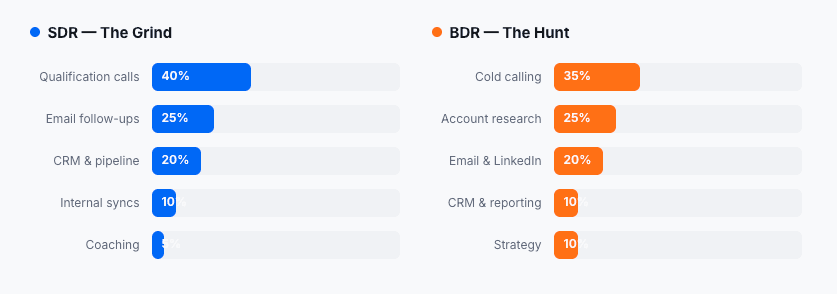
What Does an SDR Actually Do? (The Grind)
The life of an SDR is a game of volume and speed. They are the engine that processes and qualifies the interest generated by the marketing team. While it's a crucial role, it's often defined by a relentless cycle of repetitive tasks. It's a grind, but a necessary one to keep the sales pipeline full of warm leads.
A typical day for an SDR involves:
Responding to inbound demo requests and contact form submissions at lightning speed
Following up on leads who downloaded content or attended a webinar
Qualifying leads against a set of criteria (like BANT: Budget, Authority, Need, Timeline) to determine if they're a good fit
Nurturing leads that aren't quite ready to buy yet
Booking meetings and scheduling discovery calls for Account Executives
Living inside the CRM, updating contact records, and logging every single activity
SDR performance is usually measured by activity and output metrics, such as:
Number of qualified meetings booked
Lead response time
Volume of calls made and emails sent
Conversion rate from MQL (Marketing Qualified Lead) to SQL (Sales Qualified Lead)
What Does a BDR Actually Do? (The Hunt)
If the SDR manages the farm, the BDR is out hunting in the wilderness. This role is all about strategic outreach and creating new opportunities from cold accounts. BDRs are researchers and strategists, mapping out entire organizations to find the right person to talk to and crafting personalized messages to break through the noise.
A BDR's day-to-day activities are more strategic and research-intensive:
Identifying and researching target companies (accounts) that fit the Ideal Customer Profile (ICP)
Building prospect lists from scratch using tools like LinkedIn Sales Navigator and company databases
Executing cold outreach campaigns via email, phone, and social media (especially LinkedIn)
Crafting highly personalized messaging tailored to a specific company's pain points or industry
Generating interest and securing introductory meetings with key decision-makers in untapped accounts
BDRs are measured on their ability to generate new pipeline. Their key metrics often include:
Number of net new opportunities created
Conversion rate from cold outreach to meeting
The quality and value of the accounts they break into
SDR vs BDR: Key Differences at a Glance
Still a little fuzzy? It happens. Here's a side-by-side comparison to make the distinctions crystal clear. Think of it as your cheat sheet for sales role supremacy.
Characteristic | Sales Development Representative (SDR) | Business Development Representative (BDR) |
Lead Source | Inbound (Marketing Qualified Leads) | Outbound (Cold Prospecting) |
Primary Goal | Qualify existing interest and book meetings | Generate new interest and create opportunities |
Key Metrics | Meetings booked, MQL-to-SQL conversion rate, response time | Net new opportunities, meetings set in target accounts |
Primary Skills | Efficiency, speed, persistence, organization, active listening | Research, strategic thinking, personalization, resilience, creativity |
Typical Tools | CRM, marketing automation software, meeting schedulers | LinkedIn Sales Navigator, data enrichment tools, sales intelligence platforms |
Place in Funnel | Top/Middle of the Funnel (converting awareness into consideration) | Top of the Funnel (creating awareness from scratch) |
Typical Salary (OTE) | $75K – $85K | $80K – $99K |
SDR vs BDR: What Their Tech Stacks Look Like
The tools each role relies on day-to-day tell you a lot about how different the jobs really are.
A typical SDR stack is built for speed and responsiveness: HubSpot or Salesforce as the CRM, Chilipiper or Calendly for instant scheduling, Slack for real-time lead alerts from marketing, and Gong or Chorus for call recording and coaching. Everything is optimized to shorten the time between "a lead raised their hand" and "a meeting is on the AE's calendar."
A typical BDR stack is built for research and outreach at scale: LinkedIn Sales Navigator for identifying decision-makers, Apollo or ZoomInfo for contact data and enrichment, an outbound sequencing platform like Outreach or Salesloft for multichannel cadences, and a CRM to track pipeline. The workflow is heavier on preparation — finding the right person, understanding their business, then crafting a message that earns a reply.
This is exactly why AI sales platforms are gaining traction. Instead of stitching together five or six tools, platforms like Topo consolidate the entire BDR workflow — from lead data sources and enrichment to sequencing and follow-up — into a single engine that runs autonomously.
How SDRs and BDRs Fit Into a Modern Sales Team
In a well-oiled sales machine, SDRs and BDRs aren't rivals; they're partners in pipeline. They work in tandem to ensure a steady flow of opportunities reaches the closers — the Account Executives (AEs). The SDR takes the warm hand-off from marketing, qualifies it, and serves up a ready-to-talk lead to the AE. Meanwhile, the BDR is prospecting cold accounts and, upon generating interest, also books a meeting for an AE to take over.
Both roles typically report to a Sales Development Manager or a Head of Sales. This structure ensures that both inbound qualification and outbound prospecting efforts are aligned with the company's overall revenue goals. The collaboration prevents valuable inbound leads from going cold and ensures the business is actively pursuing growth in new territories.
SDR vs BDR Salary: What to Expect in 2026
One of the most-searched questions around these roles is about compensation — and for good reason. If you're considering a career in sales development or building a team, you need to know what the market pays.
Here's what the latest data from RepVue, Built In, Indeed, and SalesBread shows for the US market in 2025–2026:
Compensation Metric | SDR | BDR |
Average base salary | $55,000 – $65,000 | $58,000 – $68,000 |
Average OTE (On-Target Earnings) | $75,000 – $85,000 | $80,000 – $99,000 |
Commission structure | Per-meeting or per-SQL bonus | Per-opportunity or per-pipeline $ generated |
Entry-level base | $50,000 – $60,000 | $52,000 – $62,000 |
Top-paying cities (OTE) | Seattle (~$100K), NYC (~$90K), San Diego (~$90K) | Similar geographic premiums apply |
BDRs tend to command slightly higher compensation because outbound prospecting requires deeper strategic skills — research, personalization, and resilience through higher rejection rates. That said, the gap is often narrow, and both roles are heavily performance-based. A top-performing SDR crushing their meeting quota can out-earn an average BDR.
One important nuance: many companies use the titles interchangeably. If you're evaluating an offer, focus on the job description (inbound vs outbound focus) rather than the title to benchmark compensation accurately. For the most current numbers, check RepVue and Glassdoor for your specific market and industry.
Career Paths & Growth: Where Each Role Leads
Both SDR and BDR roles are fantastic entry points into a lucrative career in tech sales, but they can lead down slightly different paths.
An SDR, having mastered the art of qualification and discovery calls, is on a direct track to becoming an Account Executive. They've spent their days teeing up deals, so learning to close them is the natural next step. The progression typically looks like: SDR → Senior SDR → AE → Senior AE → Sales Manager.
A BDR's path can be more varied. While many also move into an AE role, their strategic research and outreach skills also open doors to roles in Strategic Partnerships, Channel Sales, or Enterprise Business Development. BDRs who excel at account mapping and executive outreach often thrive in enterprise sales cycles where deal sizes are larger and sales motions are more complex. A common BDR trajectory: BDR → Senior BDR → Enterprise BDR → AE or Partnerships Manager.
Should You Hire an SDR, a BDR, or Both?
This is the question that matters most for founders and sales leaders — and the answer depends entirely on where your pipeline comes from today and where you want it to come from tomorrow.
Hire an SDR first if:
Your marketing engine is already generating inbound leads that go unqualified or get slow follow-up
Your AEs are wasting time triaging demo requests instead of running discovery calls
Your MQL-to-SQL conversion rate is below 20% — you're leaking pipeline at the top
Hire a BDR first if:
You have a clearly defined ICP but almost no inbound pipeline to speak of
You're expanding into a new market, vertical, or geography where nobody knows your name yet
You're running an ABM strategy targeting a finite list of named accounts
Hire both if:
You have meaningful marketing spend generating inbound ($50K+/month) AND a defined list of strategic accounts you need to crack
Your sales team is large enough to absorb meetings from both channels without bottlenecking at the AE level
Consider AI agents for outbound instead if:
You're a startup or SMB with fewer than 5 salespeople and need to move fast
You can't afford the 3–6 month ramp time (and $80K+ annual cost) of a new hire
You need outbound running 24/7 but don't have the headcount to sustain it
Companies like Linkup used this approach to book 68 meetings in 3 months — without adding headcount. And Cabinet replaced their outbound agency entirely with an AI-powered outbound engine, cutting costs while increasing pipeline.
The key insight: the SDR vs BDR decision isn't just about roles anymore. It's about whether the work those roles do can be done faster, cheaper, and more consistently by AI agents working by your team's side — and where human judgment still makes the difference.
How AI Is Changing the SDR vs BDR Game (Topo's Take)
Here's the thing about "The Grind" we mentioned earlier: a lot of it is, well, robotic. Researching leads, building lists, sending hundreds of near-identical follow-up emails — these are critical tasks, but they're also repetitive, time-consuming, and a major cause of burnout. This is where most sales organizations spin their wheels and burn cash.
At Topo, we don't see AI as a replacement for skilled salespeople. We see it as the ultimate augmentation layer. Our philosophy is simple: "let robots do the robotic work so humans can do the human work." The future of outbound sales lies in the synergy between AI precision and human creativity.
This is where AI agents for outbound come in. Instead of replacing your team, AI agents handle the most time-consuming parts of the SDR and BDR workflow — the prospecting, the data enrichment, the multi-channel outreach, and the persistent follow-up. They execute the high-volume, rules-based tasks with speed and consistency that frees up your human sales team to focus on what they do best: building relationships, thinking strategically, and closing deals. In essence, AI handles the "grind" so your people can excel at the "hunt" and the "close."
When to Augment Your Team with AI Agents (Like Topo)
So, when does it make sense to bring AI agents into your outbound motion? For small and medium-sized businesses, the answer is often "yesterday." If you're a founder wearing the sales hat or a small team struggling to keep up, AI-powered outbound is a force multiplier.
Instead of debating whether to hire an SDR or a BDR (a costly decision with a long ramp-up time), you can deploy an AI sales platform to handle the entire outbound process. Topo's AI agents work by your side — trained on your specific playbook to execute hyper-targeted campaigns while you stay in control. They don't just pull from static lists; they identify real-time intent signals — like a company hiring for a specific role or adopting a new technology — to ensure your outreach is always relevant.
Think about the challenges we've discussed:
The Grind of Building Lists: Topo's AI agents monitor the market 24/7, building dynamic lead lists based on triggers you define. No more manual prospecting.
The Tedium of Outreach: Topo automates entire multichannel sequences across email and LinkedIn, including all the follow-ups you know you should be sending but don't have time for.
The Struggle for Personalization: The platform enriches lead data and uses it to craft tailored messaging that resonates with your ideal customer, leading to higher conversion rates and a better buyer experience.
By automating the repetitive tasks, you empower your team to focus on high-value activities. They can spend their time on discovery calls, creating strategic proposals, and nurturing the relationships that truly drive revenue. All your outbound, simplified — with your team doing more with the same headcount.
Curious how this stacks up? Compare Topo with other outbound tools to see the difference.