
Spotting the 'Robot' in Your Sales Emails: A Red Flag Checklist
You’ve felt it. That email that lands in your inbox and gives you the digital equivalent of an uncanny valley shiver. You know, the one that’s technically grammatically correct but has all the personality of a dial tone. That’s AI fatigue in action, and your prospects are getting better at spotting generic AI sales copy every day.
Before you can learn how to not sound like an AI in your sales emails, you need to know what a robot sounds like. Here’s a handy checklist of the red flags that scream “this was written by a machine with a limited emotional spectrum.”
The Overly Formal & Vague Opener

Does your email start with “I hope this message finds you well”? Congratulations, you’ve used the official opening line of robots, 19th-century aristocrats, and people who have absolutely no idea who you are but definitely want something. It’s a polite but meaningless phrase that builds zero connection and immediately puts your reader on the defensive.

Unnatural, Jargon-Stuffed Phrasing
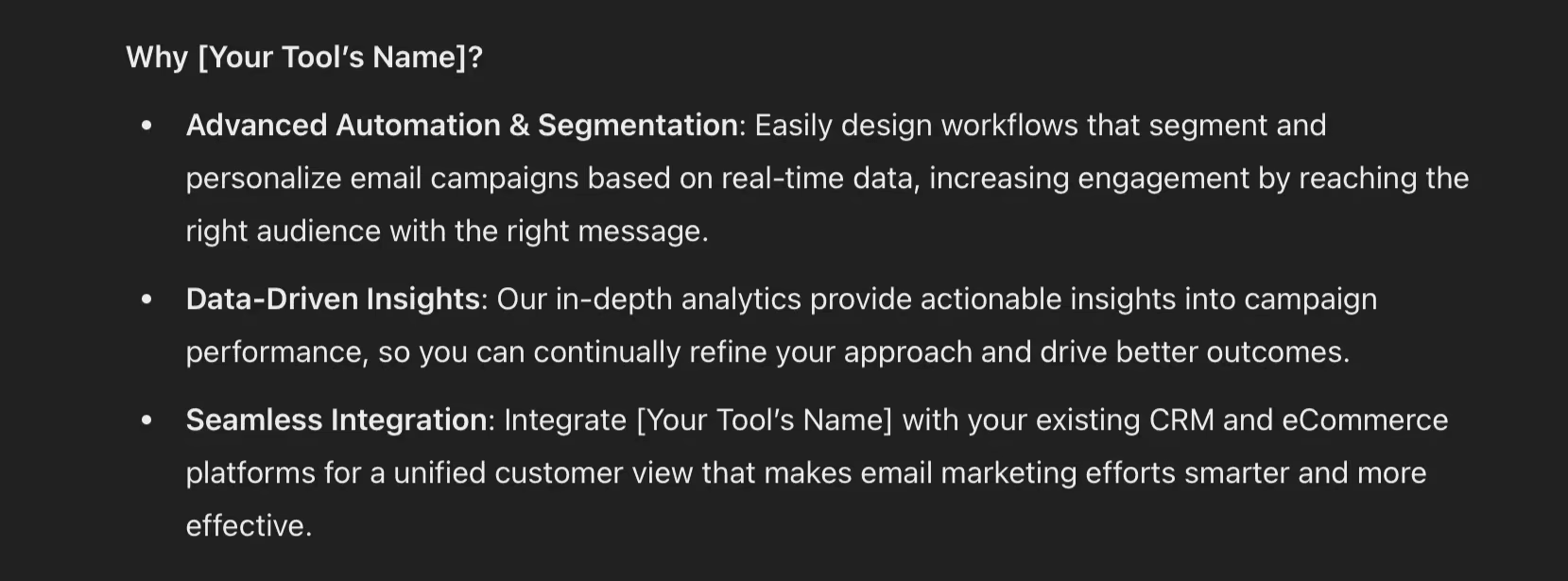
AI models love to “leverage synergies,” “optimize outcomes,” and create “unified customer views.” They string together corporate buzzwords in a way that sounds impressive if you don’t think about it too hard, but a real human would just say, “We help your teams work better together.” If your sentences feel like they were assembled from a B-school textbook, a robot is likely the culprit. For more on this, see the most common AI words to avoid in sales outreach) and what to use instead.
A Complete Lack of Specificity
Generic AI emails are masters of saying nothing with a lot of words. They’ll praise your company for being a “leader in the industry” without naming a single achievement. They’ll offer to “drive significant growth” without mentioning a specific metric. This lack of detail shows the sender hasn’t done a shred of research and is just blasting a template to the wind.
Monotone, Formulaic Structure
Most bad AI emails follow a painfully predictable script: Greeting > Vague Compliment > Our Product Value Prop > Our Product Benefits > Generic CTA. There’s no storytelling, no change in pace, and no personality. It’s a robotic march from start to finish that is profoundly unengaging and easy to ignore.
The Weak, Non-Committal CTA
The call-to-action is where the robot really shows its circuits. You’ll see phrases like, “I’d love to tell you more,” “Are you available for a quick chat?” or “Let me know if this is of interest.” These are passive, weak, and put all the work on the prospect. A human who is confident in their value proposes a clear, specific next step.
How to Humanize Your AI-Generated Sales Emails (Step-by-Step)
Alright, enough diagnosing the problem. It’s time to fix it. Escaping the AI uncanny valley isn’t about abandoning AI altogether; it’s about using it as a starting point, a first-draft-bot that you, the human strategist, elevate to greatness. Here’s your step-by-step process for refining AI-generated emails.
Step 1: Master Your Prompt Engineering
Garbage in, garbage out. A lazy prompt like “Write a sales email for my product” will get you a lazy, robotic email. To get a better starting point, you need to give the AI context. Think of it as a new SDR you’re briefing for the first time.
Your prompt should include:
Persona: “Act as a friendly, slightly sarcastic sales expert who has been in the trenches.”
Tone: “Write in a pragmatic, helpful, and confident tone. Use short sentences. Avoid corporate jargon.”
Goal: “The goal of this email is to book a 15-minute discovery call, not to sell the whole product.”
Context: “The prospect is a Head of Sales at a Series A tech startup. Their company just posted a job for 5 new SDRs, so they are likely focused on scaling their outbound efforts.”
Step 2: Inject Your Authentic Brand Voice
The AI gives you the clay; you have to shape it. Read the AI’s draft and rewrite it in your own voice. If your brand is playful, add a witty aside. If you’re more direct, cut the fluff. This is where you replace generic phrases with your company’s unique perspective, terminology, or even an inside joke relevant to your industry. This is the part that makes the email yours.
Step 3: Personalize with Precision, Not Just Placeholders
Personalization is more than just {{first\_name}} and {{company\_name}}. That’s table stakes. True personalization shows you’ve done your homework. Reference something specific:
A recent LinkedIn post they wrote or commented on.
A company funding announcement or product launch.
A podcast they appeared on or an article they were quoted in.
A shared connection or a common past employer.
This one detail instantly proves the email wasn’t sent by a mindless bot and earns you the right to their attention.
Step 4: Craft a Compelling, Actionable CTA
Ditch the passive CTAs. Be bold and specific. A great CTA makes it easy for the prospect to say yes by proposing a clear, low-friction next step. Instead of “Are you free to chat?”, try:
“Does 15 minutes next Tuesday or Wednesday afternoon work to see if this is even a fit?”
“If this sounds interesting, feel free to grab a time on my calendar here: [Booking Link]”
Step 5: The Final Human Polish
This is the most critical step. Read the entire email out loud. Does it sound like something you would actually say to another person? If you stumble over a phrase or cringe at a sentence, rewrite it. This simple act catches awkward phrasing and robotic tendencies that look fine on paper but sound alien when spoken. This is the essence of the “Human-in-the-Loop” approach.
Real-World Examples: Before & After the Human Touch
Let’s see the theory in action. Imagine we’re selling a project management tool. Here’s the generic AI-generated first draft and the human-refined final version.
The ‘Before’: A Classic Robot Email
Subject: Enhancing Your Team's Productivity
Dear Sarah,
I hope this message finds you well. I am reaching out because I saw that you are the Head of Operations at a leading tech company.
My company, SynchroCorp, has developed a revolutionary platform designed to optimize workflows and boost team efficiency. Our solution offers a unified view of all ongoing projects, empowering teams to achieve their goals faster.
Would you be open to a brief conversation to explore how we can support your strategic objectives?
Best regards,
AI Sales Bot 3000
Why it fails: It’s a festival of red flags. “Hope this finds you well,” vague praise (“leading tech company”), corporate jargon (“optimize workflows,” “strategic objectives”), and a weak, non-specific CTA. It screams “template.”
The ‘After’: Humanized and Hyper-Relevant
Subject: That LinkedIn post about Q4 planning
Hi Sarah,
Saw your post on LinkedIn about the chaos of Q4 planning. The comment about “herding cats through a spreadsheet maze” really hit home.
Most teams we talk to face the same issue. They’re stuck with tools that weren't built for how fast modern teams actually move. It’s why we built Topo—to kill the spreadsheet maze for good.
We helped a similar company, Acme Inc., cut their project reporting time by 50% in the first month. Given you’re gearing up for 2025 planning, I thought you might find our approach interesting.
Does 15 minutes next Tuesday afternoon work to see if we can do the same for you?
Cheers,
A Real Human
Why it works: The subject line is a pattern interrupt. It opens with precise, genuine personalization. It translates jargon (“optimize workflows”) into a relatable problem (“herding cats through a spreadsheet maze”). It uses social proof (“Acme Inc. cut reporting time by 50%”) and ends with a specific, confident CTA.
Beyond the Basics: Expert Tips for Blending AI Efficiency with Human Insight
Once you’ve mastered the fundamentals of humanizing your AI sales copy, it’s time to level up. The best sales emails don’t just inform; they persuade. They tap into basic human psychology to build trust and create a desire to engage—something a generic AI can’t replicate.
Leverage the Principle of Reciprocity
The rule is simple: give value before you ask for value. Instead of immediately asking for a 30-minute demo, offer something genuinely useful upfront. A generic AI will offer a “consultation,” but a human-led strategy offers real value.
Instead of: “I’d love to show you a demo.”
Try: “Based on your company’s recent expansion into the EU market, I put together a quick, 3-point checklist of common compliance pitfalls. Happy to send it over—no strings attached.”

Incorporate Powerful Social Proof
People trust people like them. Generic AI might say, “Many companies trust us.” A humanized email says, “We just helped [Competitor Name] solve the exact problem you mentioned in your recent podcast interview.” Mentioning specific, relevant customers, impressive and believable statistics, or mutual connections creates instant credibility that no amount of robotic prose can match.
Topo’s Approach: Authenticity at Scale
So, you now have a solid playbook on how to not sound like an AI in your sales emails. But as you look at the steps—deep research for personalization, careful rewriting for tone, crafting custom value props—you might be thinking, “This sounds great, but it also sounds like a lot of manual work.”
And you’re right. Doing it all by hand is the very reason sales teams turned to AI in the first place.
This is the paradox that most AI for sales teams miss. They offer efficiency but sacrifice the authenticity that actually gets replies. At Topo, we built our platform to solve this exact problem. We don’t just give you a better first draft; we blend AI automation with human strategy to deliver authenticity at scale.
Here’s how our approach makes this entire guide a reality, without the manual grind:
Replicative AI, Not Just Generative: Unlike generic tools trained on the whole internet, Topo’s Replicative AI learns from your most successful outreach. Our AI agents are trained on your specific outbound playbook, internalizing your brand voice, value propositions, and what actually resonates with your ideal customers.
Automated, Precise Personalization: Remember Step 3? Our AI agents and scraper assistants automate that deep research. They monitor high-value intent signals)—like job postings, tech stack changes, and funding rounds—to generate hyper-relevant opening lines and talking points, ensuring every email is grounded in a real, timely context.
The Human-in-the-Loop, Built-In: We practice what we preach. Every Topo customer works with a dedicated Account Strategist. They are your human-in-the-loop, ensuring your campaign strategy is sound, your AI’s tone is perfect, and your results are continuously improving. It’s the perfect synergy of machine efficiency and human expertise.
The goal isn’t just to avoid sounding like a robot. It’s to sound like the most informed, relevant, and helpful version of yourself, in every single email. That’s how you build a pipeline in the AI era. Ready to see how it works? Explore Topo today and discover a solution that’s 10 times cheaper than hiring an SDR but drives incredible results for your lead gen strategy.
Spotting the 'Robot' in Your Sales Emails: A Red Flag Checklist
You’ve felt it. That email that lands in your inbox and gives you the digital equivalent of an uncanny valley shiver. You know, the one that’s technically grammatically correct but has all the personality of a dial tone. That’s AI fatigue in action, and your prospects are getting better at spotting generic AI sales copy every day.
Before you can learn how to not sound like an AI in your sales emails, you need to know what a robot sounds like. Here’s a handy checklist of the red flags that scream “this was written by a machine with a limited emotional spectrum.”
The Overly Formal & Vague Opener

Does your email start with “I hope this message finds you well”? Congratulations, you’ve used the official opening line of robots, 19th-century aristocrats, and people who have absolutely no idea who you are but definitely want something. It’s a polite but meaningless phrase that builds zero connection and immediately puts your reader on the defensive.
Unnatural, Jargon-Stuffed Phrasing
AI models love to “leverage synergies,” “optimize outcomes,” and create “unified customer views.” They string together corporate buzzwords in a way that sounds impressive if you don’t think about it too hard, but a real human would just say, “We help your teams work better together.” If your sentences feel like they were assembled from a B-school textbook, a robot is likely the culprit. For more on this, see the most common AI words to avoid in sales outreach) and what to use instead.

A Complete Lack of Specificity
Generic AI emails are masters of saying nothing with a lot of words. They’ll praise your company for being a “leader in the industry” without naming a single achievement. They’ll offer to “drive significant growth” without mentioning a specific metric. This lack of detail shows the sender hasn’t done a shred of research and is just blasting a template to the wind.
Monotone, Formulaic Structure
Most bad AI emails follow a painfully predictable script: Greeting > Vague Compliment > Our Product Value Prop > Our Product Benefits > Generic CTA. There’s no storytelling, no change in pace, and no personality. It’s a robotic march from start to finish that is profoundly unengaging and easy to ignore.
The Weak, Non-Committal CTA
The call-to-action is where the robot really shows its circuits. You’ll see phrases like, “I’d love to tell you more,” “Are you available for a quick chat?” or “Let me know if this is of interest.” These are passive, weak, and put all the work on the prospect. A human who is confident in their value proposes a clear, specific next step.
How to Humanize Your AI-Generated Sales Emails (Step-by-Step)
Alright, enough diagnosing the problem. It’s time to fix it. Escaping the AI uncanny valley isn’t about abandoning AI altogether; it’s about using it as a starting point, a first-draft-bot that you, the human strategist, elevate to greatness. Here’s your step-by-step process for refining AI-generated emails.
Step 1: Master Your Prompt Engineering
Garbage in, garbage out. A lazy prompt like “Write a sales email for my product” will get you a lazy, robotic email. To get a better starting point, you need to give the AI context. Think of it as a new SDR you’re briefing for the first time.
Your prompt should include:
Persona: “Act as a friendly, slightly sarcastic sales expert who has been in the trenches.”
Tone: “Write in a pragmatic, helpful, and confident tone. Use short sentences. Avoid corporate jargon.”
Goal: “The goal of this email is to book a 15-minute discovery call, not to sell the whole product.”
Context: “The prospect is a Head of Sales at a Series A tech startup. Their company just posted a job for 5 new SDRs, so they are likely focused on scaling their outbound efforts.”
Step 2: Inject Your Authentic Brand Voice
The AI gives you the clay; you have to shape it. Read the AI’s draft and rewrite it in your own voice. If your brand is playful, add a witty aside. If you’re more direct, cut the fluff. This is where you replace generic phrases with your company’s unique perspective, terminology, or even an inside joke relevant to your industry. This is the part that makes the email yours.
Step 3: Personalize with Precision, Not Just Placeholders
Personalization is more than just {{first\_name}} and {{company\_name}}. That’s table stakes. True personalization shows you’ve done your homework. Reference something specific:
A recent LinkedIn post they wrote or commented on.
A company funding announcement or product launch.
A podcast they appeared on or an article they were quoted in.
A shared connection or a common past employer.
This one detail instantly proves the email wasn’t sent by a mindless bot and earns you the right to their attention.
Step 4: Craft a Compelling, Actionable CTA
Ditch the passive CTAs. Be bold and specific. A great CTA makes it easy for the prospect to say yes by proposing a clear, low-friction next step. Instead of “Are you free to chat?”, try:
“Does 15 minutes next Tuesday or Wednesday afternoon work to see if this is even a fit?”
“If this sounds interesting, feel free to grab a time on my calendar here: [Booking Link]”
Step 5: The Final Human Polish
This is the most critical step. Read the entire email out loud. Does it sound like something you would actually say to another person? If you stumble over a phrase or cringe at a sentence, rewrite it. This simple act catches awkward phrasing and robotic tendencies that look fine on paper but sound alien when spoken. This is the essence of the “Human-in-the-Loop” approach.
Real-World Examples: Before & After the Human Touch
Let’s see the theory in action. Imagine we’re selling a project management tool. Here’s the generic AI-generated first draft and the human-refined final version.
The ‘Before’: A Classic Robot Email
Subject: Enhancing Your Team's Productivity
Dear Sarah,
I hope this message finds you well. I am reaching out because I saw that you are the Head of Operations at a leading tech company.
My company, SynchroCorp, has developed a revolutionary platform designed to optimize workflows and boost team efficiency. Our solution offers a unified view of all ongoing projects, empowering teams to achieve their goals faster.
Would you be open to a brief conversation to explore how we can support your strategic objectives?
Best regards,
AI Sales Bot 3000
Why it fails: It’s a festival of red flags. “Hope this finds you well,” vague praise (“leading tech company”), corporate jargon (“optimize workflows,” “strategic objectives”), and a weak, non-specific CTA. It screams “template.”
The ‘After’: Humanized and Hyper-Relevant
Subject: That LinkedIn post about Q4 planning
Hi Sarah,
Saw your post on LinkedIn about the chaos of Q4 planning. The comment about “herding cats through a spreadsheet maze” really hit home.
Most teams we talk to face the same issue. They’re stuck with tools that weren't built for how fast modern teams actually move. It’s why we built Topo—to kill the spreadsheet maze for good.
We helped a similar company, Acme Inc., cut their project reporting time by 50% in the first month. Given you’re gearing up for 2025 planning, I thought you might find our approach interesting.
Does 15 minutes next Tuesday afternoon work to see if we can do the same for you?
Cheers,
A Real Human
Why it works: The subject line is a pattern interrupt. It opens with precise, genuine personalization. It translates jargon (“optimize workflows”) into a relatable problem (“herding cats through a spreadsheet maze”). It uses social proof (“Acme Inc. cut reporting time by 50%”) and ends with a specific, confident CTA.
Beyond the Basics: Expert Tips for Blending AI Efficiency with Human Insight
Once you’ve mastered the fundamentals of humanizing your AI sales copy, it’s time to level up. The best sales emails don’t just inform; they persuade. They tap into basic human psychology to build trust and create a desire to engage—something a generic AI can’t replicate.
Leverage the Principle of Reciprocity
The rule is simple: give value before you ask for value. Instead of immediately asking for a 30-minute demo, offer something genuinely useful upfront. A generic AI will offer a “consultation,” but a human-led strategy offers real value.
Instead of: “I’d love to show you a demo.”
Try: “Based on your company’s recent expansion into the EU market, I put together a quick, 3-point checklist of common compliance pitfalls. Happy to send it over—no strings attached.”

Incorporate Powerful Social Proof
People trust people like them. Generic AI might say, “Many companies trust us.” A humanized email says, “We just helped [Competitor Name] solve the exact problem you mentioned in your recent podcast interview.” Mentioning specific, relevant customers, impressive and believable statistics, or mutual connections creates instant credibility that no amount of robotic prose can match.
Topo’s Approach: Authenticity at Scale
So, you now have a solid playbook on how to not sound like an AI in your sales emails. But as you look at the steps—deep research for personalization, careful rewriting for tone, crafting custom value props—you might be thinking, “This sounds great, but it also sounds like a lot of manual work.”
And you’re right. Doing it all by hand is the very reason sales teams turned to AI in the first place.
This is the paradox that most AI for sales teams miss. They offer efficiency but sacrifice the authenticity that actually gets replies. At Topo, we built our platform to solve this exact problem. We don’t just give you a better first draft; we blend AI automation with human strategy to deliver authenticity at scale.
Here’s how our approach makes this entire guide a reality, without the manual grind:
Replicative AI, Not Just Generative: Unlike generic tools trained on the whole internet, Topo’s Replicative AI learns from your most successful outreach. Our AI agents are trained on your specific outbound playbook, internalizing your brand voice, value propositions, and what actually resonates with your ideal customers.
Automated, Precise Personalization: Remember Step 3? Our AI agents and scraper assistants automate that deep research. They monitor high-value intent signals)—like job postings, tech stack changes, and funding rounds—to generate hyper-relevant opening lines and talking points, ensuring every email is grounded in a real, timely context.
The Human-in-the-Loop, Built-In: We practice what we preach. Every Topo customer works with a dedicated Account Strategist. They are your human-in-the-loop, ensuring your campaign strategy is sound, your AI’s tone is perfect, and your results are continuously improving. It’s the perfect synergy of machine efficiency and human expertise.
The goal isn’t just to avoid sounding like a robot. It’s to sound like the most informed, relevant, and helpful version of yourself, in every single email. That’s how you build a pipeline in the AI era. Ready to see how it works? Explore Topo today and discover a solution that’s 10 times cheaper than hiring an SDR but drives incredible results for your lead gen strategy.
FAQ
How is 'humanizing' an AI email different from just adding a {{first_name}} tag?
Humanizing goes way beyond basic placeholders. It involves rewriting robotic phrases to match your authentic brand voice, referencing specific details about the prospect (like a recent LinkedIn post or company news), and crafting a compelling call-to-action. It’s about proving a real person did their homework, not just filling in a template.
How is 'humanizing' an AI email different from just adding a {{first_name}} tag?
Humanizing goes way beyond basic placeholders. It involves rewriting robotic phrases to match your authentic brand voice, referencing specific details about the prospect (like a recent LinkedIn post or company news), and crafting a compelling call-to-action. It’s about proving a real person did their homework, not just filling in a template.
How is 'humanizing' an AI email different from just adding a {{first_name}} tag?
Humanizing goes way beyond basic placeholders. It involves rewriting robotic phrases to match your authentic brand voice, referencing specific details about the prospect (like a recent LinkedIn post or company news), and crafting a compelling call-to-action. It’s about proving a real person did their homework, not just filling in a template.
How is 'humanizing' an AI email different from just adding a {{first_name}} tag?
Humanizing goes way beyond basic placeholders. It involves rewriting robotic phrases to match your authentic brand voice, referencing specific details about the prospect (like a recent LinkedIn post or company news), and crafting a compelling call-to-action. It’s about proving a real person did their homework, not just filling in a template.
Can AI learn my specific writing style and tone?
Yes, with the right approach. While generic AI needs detailed prompts about persona and tone for every task, more advanced systems like Topo’s Replicative AI learn from your most successful emails. It internalizes your specific brand voice and winning strategies to consistently generate outreach that actually sounds like you.
Can AI learn my specific writing style and tone?
Yes, with the right approach. While generic AI needs detailed prompts about persona and tone for every task, more advanced systems like Topo’s Replicative AI learn from your most successful emails. It internalizes your specific brand voice and winning strategies to consistently generate outreach that actually sounds like you.
Can AI learn my specific writing style and tone?
Yes, with the right approach. While generic AI needs detailed prompts about persona and tone for every task, more advanced systems like Topo’s Replicative AI learn from your most successful emails. It internalizes your specific brand voice and winning strategies to consistently generate outreach that actually sounds like you.
Can AI learn my specific writing style and tone?
Yes, with the right approach. While generic AI needs detailed prompts about persona and tone for every task, more advanced systems like Topo’s Replicative AI learn from your most successful emails. It internalizes your specific brand voice and winning strategies to consistently generate outreach that actually sounds like you.
What are the best prompts to use in ChatGPT for sales emails that don't sound robotic?
Great prompts provide deep context. Instead of a lazy request, brief the AI like a new SDR. Include the persona ('act as a friendly sales expert'), tone ('use short sentences, avoid jargon'), goal ('book a 15-minute call'), and specific context about the prospect, like their role and recent company activity.
What are the best prompts to use in ChatGPT for sales emails that don't sound robotic?
Great prompts provide deep context. Instead of a lazy request, brief the AI like a new SDR. Include the persona ('act as a friendly sales expert'), tone ('use short sentences, avoid jargon'), goal ('book a 15-minute call'), and specific context about the prospect, like their role and recent company activity.
What are the best prompts to use in ChatGPT for sales emails that don't sound robotic?
Great prompts provide deep context. Instead of a lazy request, brief the AI like a new SDR. Include the persona ('act as a friendly sales expert'), tone ('use short sentences, avoid jargon'), goal ('book a 15-minute call'), and specific context about the prospect, like their role and recent company activity.
What are the best prompts to use in ChatGPT for sales emails that don't sound robotic?
Great prompts provide deep context. Instead of a lazy request, brief the AI like a new SDR. Include the persona ('act as a friendly sales expert'), tone ('use short sentences, avoid jargon'), goal ('book a 15-minute call'), and specific context about the prospect, like their role and recent company activity.
What's the difference between Generative AI and Replicative AI for sales outreach?
Generative AI (like ChatGPT) is trained on the whole internet and creates new content based on general patterns, which often results in generic copy. Replicative AI, like Topo's, is trained specifically on *your* successful outreach. It learns what works for your brand and your customers, replicating that success to create highly relevant and authentic emails at scale.
What's the difference between Generative AI and Replicative AI for sales outreach?
Generative AI (like ChatGPT) is trained on the whole internet and creates new content based on general patterns, which often results in generic copy. Replicative AI, like Topo's, is trained specifically on *your* successful outreach. It learns what works for your brand and your customers, replicating that success to create highly relevant and authentic emails at scale.
What's the difference between Generative AI and Replicative AI for sales outreach?
Generative AI (like ChatGPT) is trained on the whole internet and creates new content based on general patterns, which often results in generic copy. Replicative AI, like Topo's, is trained specifically on *your* successful outreach. It learns what works for your brand and your customers, replicating that success to create highly relevant and authentic emails at scale.
What's the difference between Generative AI and Replicative AI for sales outreach?
Generative AI (like ChatGPT) is trained on the whole internet and creates new content based on general patterns, which often results in generic copy. Replicative AI, like Topo's, is trained specifically on *your* successful outreach. It learns what works for your brand and your customers, replicating that success to create highly relevant and authentic emails at scale.
Sources and references
Topo editorial line asks its authors to use sources to support their work. These can include original reporting, articles, white papers, product data, benchmarks and interviews with industry experts. We prioritize primary sources and authoritative references to ensure accuracy and credibility in all content related to B2B marketing, lead generation, and sales strategies.
Sources and references for this article
Sources and references
Topo editorial line asks its authors to use sources to support their work. These can include original reporting, articles, white papers, product data, benchmarks and interviews with industry experts. We prioritize primary sources and authoritative references to ensure accuracy and credibility in all content related to B2B marketing, lead generation, and sales strategies.
Sources and references for this article
Sources and references
Topo editorial line asks its authors to use sources to support their work. These can include original reporting, articles, white papers, product data, benchmarks and interviews with industry experts. We prioritize primary sources and authoritative references to ensure accuracy and credibility in all content related to B2B marketing, lead generation, and sales strategies.
Sources and references for this article
Sources and references
Topo editorial line asks its authors to use sources to support their work. These can include original reporting, articles, white papers, product data, benchmarks and interviews with industry experts. We prioritize primary sources and authoritative references to ensure accuracy and credibility in all content related to B2B marketing, lead generation, and sales strategies.
Sources and references for this article

