

ON THIS PAGE
TL;DR — Key Takeaways
The AE role in tech is trending toward full-cycle ownership — not because every company has adopted it, but because market conditions and ROI math increasingly favor it over the traditional SDR+AE tandem.
Even in orgs that still split SDR and AE functions, AEs who generate own-sourced pipeline are consistently among the top performers — and it's one of the clearest green flags for sales leadership when evaluating promotions.
AI tools now automate 30%+ of an AE's pipeline-building work — shifting their time toward strategic selling and relationship nurturing.
Top AEs in tech earn between $135K–$270K OTE depending on market segment (source: RepVue, 2026 data). Career progression typically follows SDR → SMB AE → Mid-Market AE → Enterprise AE → Sales Manager.
What Is an Account Executive in Sales?
An Account Executive (AE) is the primary revenue driver on a B2B sales team. They own the relationship between a company and its prospects or clients — from initial outreach to signed contract and beyond.
In practical terms, AEs are responsible for building trust with buyers, understanding their pain points, presenting solutions that fit, negotiating terms, and closing deals. They also collaborate closely with customer success, marketing, and product teams to ensure what they sell actually gets delivered.
The "AE" title means different things at different companies. At large enterprises, an AE might only handle the closing stage after a Sales Development Representative (SDR) qualifies the lead. At smaller tech companies and startups, the AE often owns the entire cycle — which is why the term "full-cycle AE" has become increasingly common in the tech hiring market.
That said, even in organizations that maintain a dedicated SDR team, the AEs who consistently generate their own pipeline — so-called "own-sourced deals" — stand out. In fact, an AE's ability to self-source is one of the strongest signals sales leadership looks for when evaluating promotions and leadership potential. It demonstrates initiative, market awareness, and the kind of full-ownership mindset that scales.
AE vs. SDR: What's the Difference?
The distinction is simple but important. SDRs focus on the top of the funnel: identifying prospects, qualifying interest, and booking meetings. AEs take it from there: running discovery calls, delivering demos, managing objections, negotiating contracts, and closing revenue. For a deeper dive on how these two roles interact, see our guide on AE vs. SDR collaboration.
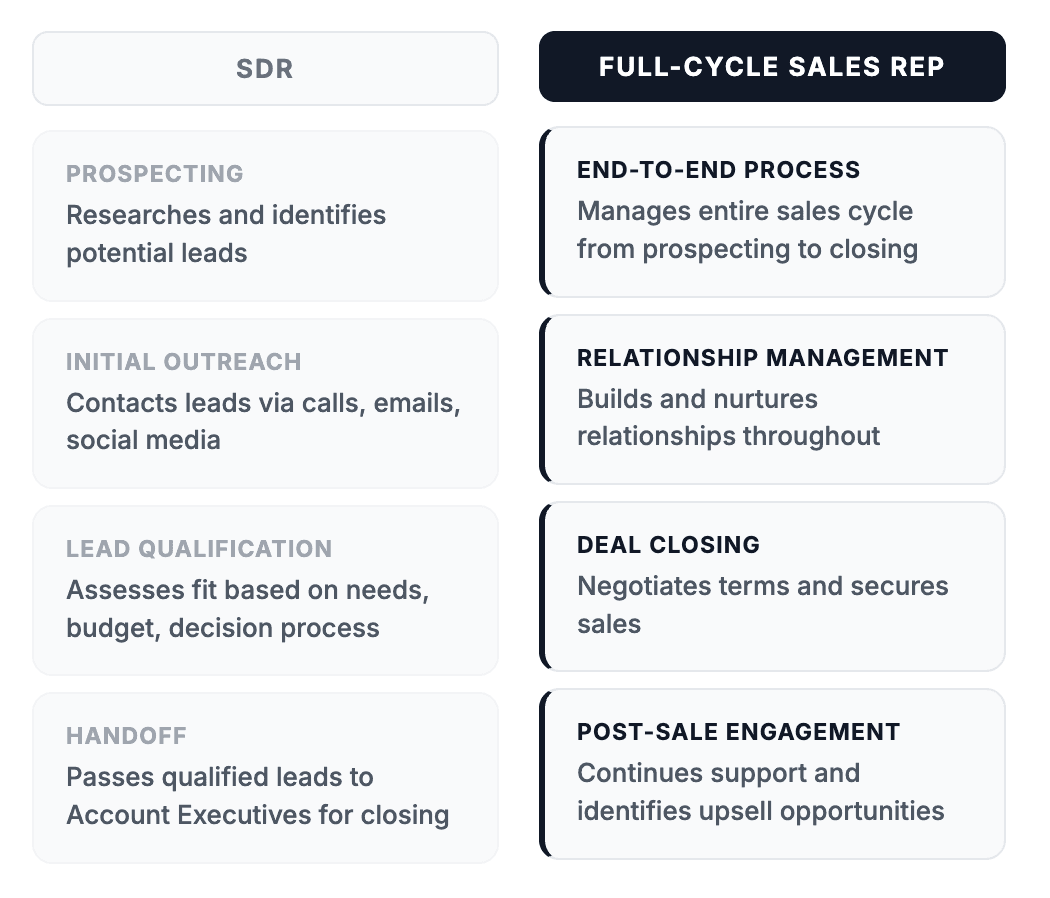
In a full-cycle model, the AE does both — which eliminates handoff friction but demands a broader skillset and better time management.
SDR | Account Executive (AE) | |
Primary focus | Lead qualification + meeting booking | Deal progression + closing |
Owns the relationship? | Temporary (hands off after qualification) | End-to-end |
Compensation model | Lower base, activity-based bonuses | Higher base + commission on closed revenue |
Typical experience | 0–2 years in sales | 2–5+ years |
Key metric | Meetings booked, qualified pipeline created | Revenue closed, average deal size, |
Core Skills Every Tech AE Needs in 2026
The best AEs aren't just good closers — they're consultative sellers who deeply understand their buyer's world. Here are the skills that separate top performers from average ones:
1. Consultative Selling & Discovery
The days of feature-dumping on a demo are over. Modern tech buyers expect AEs to diagnose their problems before prescribing a solution. Strong discovery — asking the right questions, actively listening, and mapping pain to outcomes — is the single highest-leverage skill for any AE.
2. Storytelling & Narrative Building
Deals are won on narratives, not feature comparisons. Top AEs frame their product as the "before and after" of their buyer's situation — painting a vivid picture of the current pain, the desired future state, and the cost of inaction.
3. Technical Fluency (Not Expertise)
AEs in tech don't need to write code, but they do need to understand APIs, integrations, data flows, and security requirements well enough to hold credible conversations with technical stakeholders. The ability to translate technical capabilities into business outcomes is what separates tech AEs from generalists.
4. Data Literacy & CRM Discipline
Your CRM is your operating system. AEs who keep their pipeline clean, log activities consistently, and use data to prioritize accounts are dramatically more effective than those who fly blind. This also means knowing how to read dashboards, interpret conversion metrics, and spot deal risks early.
5. AI Tool Fluency
This is the new frontier. AEs who know how to use AI tools for sales prospecting — for prospect research, email personalization, meeting prep, and follow-up automation — can compress hours of manual work into minutes. It's not optional anymore: AI fluency is quickly becoming a gating factor for both hiring and promotion at competitive tech companies.
6. Multi-Threading & Stakeholder Management
Enterprise deals involve 6–10 decision-makers on average. AEs need to identify, map, and engage multiple stakeholders across departments — building champions, neutralizing blockers, and aligning buying committees around a shared decision.
What Does an Account Executive Earn in Tech?
Compensation varies significantly by segment, geography, and company stage. Here are the latest benchmarks for tech AEs in 2026 based on data from RepVue and Glassdoor (US market, SaaS companies):
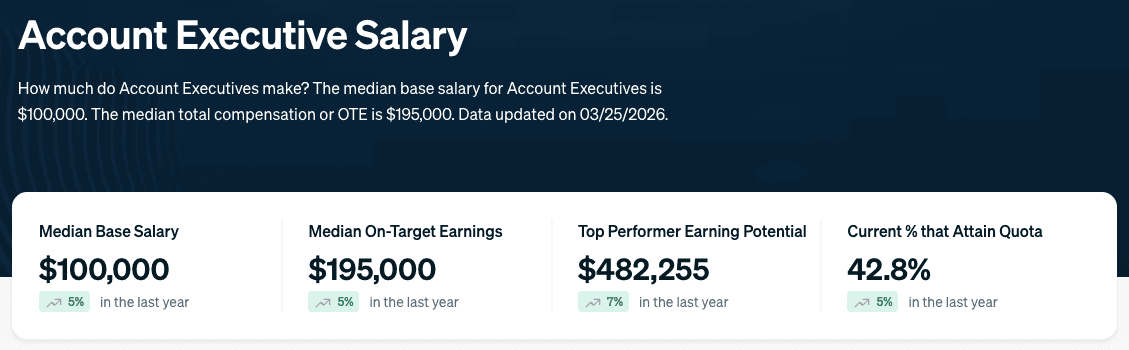
Split by target segments
Segment | Median Base Salary | Median | Typical Quota |
SMB AE | $70K | $135K | $400K–$700K ARR |
Mid-Market AE | $90K | $180K | $700K–$1.2M ARR |
Enterprise AE | $140K | $270K | $1M–$3M+ ARR |
Sources: RepVue SMB AE salaries, RepVue Mid-Market AE salaries, RepVue Enterprise AE salaries — median values, March 2026.
Most tech companies use a 50/50 base-to-variable split, with a standard commission rate of around 10% on closed deals. Top performers earning accelerators can push total comp well above OTE — according to RepVue, the highest-earning AEs exceed $480K in annual total compensation. Multi-year deal accelerators (paying 12–13% instead of 10% on contracts longer than 12 months) are increasingly common in SaaS comp plans.
Only about 43% of AEs hit or exceed their annual quota (RepVue,2026) — which means the gap between average and top-performing AEs in actual take-home pay is massive.
Note: These figures reflect US-based SaaS roles. European and APAC markets typically run 15–30% lower in base salary but the gap is narrowing, especially in the UK, France, and DACH regions.
Career Path: From SDR to Sales Leadership
The AE role sits at the center of a well-defined career ladder in tech sales. Here's how the progression typically works:
SDR / BDR (0–2 years) → You learn the basics: cold outreach, qualification frameworks (BANT, MEDDIC), CRM hygiene, and rejection resilience. This is where you prove you can generate pipeline. For a full breakdown of the SDR career track, see our sales career path guide.
SMB Account Executive (2–4 years) → Your first closing role. Shorter sales cycles, smaller deal sizes, high volume. You learn to run the full sales cycle independently and hit quota consistently.
Mid-Market Account Executive (3–6 years) → Larger deals, longer cycles, more stakeholders. You learn multi-threading, champion building, and complex negotiation. This is where most AEs either plateau or break through.
Enterprise Account Executive (5–10+ years) → Strategic, named-account selling. Six-figure deals, 6–12 month cycles, executive-level relationships. Requires deep industry knowledge and a consultative approach.
From there, top AEs typically branch into one of two paths: Sales Management (leading a team of AEs) or Strategic / Principal AE roles (individual contributor, highest-value accounts, often with VP-level comp).
What accelerates the climb in 2026? AI fluency, industry specialization, and a track record of consistent over-quota performance. Companies increasingly look for AEs who can demonstrate how they use AI tools to improve efficiency — it signals adaptability and scalability.
A Day in the Life of a Full-Cycle AE (with AI)
What does a typical day actually look like for an AE at a 50–200 person tech company using AI tools? Here's a realistic breakdown:
8:00 AM — Pipeline review & prioritization. Open your CRM dashboard. AI has already flagged the 5 accounts showing the highest buying signals overnight — website visits, content downloads, email re-engagement. You re-prioritize your day around these signals instead of working a static list.
8:30 AM — Outbound block. Draft and send personalized outreach sequences to 15–20 new prospects. AI handles the first-draft writing based on each prospect's LinkedIn activity, company news, and tech stack — you review, tweak the angle, and hit send. What used to take 2 hours now takes 40 minutes.
9:30 AM — Discovery calls. Back-to-back 30-minute calls with two qualified prospects. You're armed with AI-generated company briefs: org chart, recent funding, competitive landscape, likely pain points. The prep that used to take 20 minutes per call took 30 seconds.
11:00 AM — Internal sync. Quick standup with your SDR (if you have one), marketing, and CS to align on target accounts, share deal intel, and coordinate on expansion opportunities within existing customers.
11:30 AM — Demo / solution presentation. Live product walkthrough for a mid-funnel prospect. You tailor the demo to their specific use case — referencing pain points from the discovery call and mapping features directly to their stated goals.
12:30 PM — Lunch + learning. Review a competitor's new product launch. Read two industry articles. Stay sharp.
1:30 PM — Deal management. Update CRM, move deals through stages, write follow-up emails. AI drafts the follow-ups based on call notes and next steps — you personalize and send. Log key objections and blockers for each deal so you can strategize around them.
2:30 PM — Negotiation / proposal work. Prepare and send a proposal to a late-stage prospect. Review contract redlines with legal. Negotiate pricing with a champion who's socializing the deal internally.
4:00 PM — Relationship nurturing. Send a relevant article to a prospect who's gone quiet. Comment on a champion's LinkedIn post. Send a quick video message to re-engage a stalled deal. These micro-touches compound over time.
4:30 PM — End of day planning. Review tomorrow's calendar. Confirm meetings. Set 3 priorities for the morning. Log any at-risk deals and flag them for your manager.
The through-line here is that AI doesn't replace the AE's judgment — it removes the friction between knowing what to do and actually doing it. The research, the drafting, the data entry — all compressed, so the AE spends more time in conversation and less time in spreadsheets.
Full-Cycle AE vs. SDR + AE Tandem: Which Model Works Best?
This is one of the most debated questions in tech sales org design — and there's no universal answer. The right model depends on your company stage, deal complexity, team size, and go-to-market motion. That said, the trend is clear: more companies are moving toward full-cycle models, driven by tighter budgets, AI automation, and a growing body of evidence that owning the full buyer relationship produces better outcomes.
Full-Cycle AE Model | SDR + AE Tandem Model | |
Best for | Startups, SMBs, companies with 50–200 employees | Larger orgs (200+), high-volume outbound motions |
Deal velocity | Faster — no handoff friction | Slower — qualification handoff creates lag |
Relationship quality | Stronger — one person owns the full journey | Fragmented — buyer talks to 2+ people before closing |
AE overhead | Higher per-person workload | Lower per-person, but 2x headcount cost |
Pipeline consistency | Depends on AE discipline + AI support | More predictable with dedicated SDR pipeline |
Cost efficiency | Much leaner — especially with AI automation | Expensive — 2 salaries per "unit" of pipeline |
Main risk | AE burnout if pipeline generation isn't automated | Handoff errors, misaligned incentives between SDR and AE |
The trend toward full-cycle isn't about declaring one model "right" — it's about ROI. In today's market, with AI tools capable of automating a significant chunk of pipeline generation, the economics increasingly favor giving AEs more ownership of the full cycle rather than splitting it across two roles.
That said, the SDR role isn't going anywhere. In high-volume outbound motions, enterprise orgs, and companies selling into complex multi-stakeholder environments, a dedicated SDR team still makes sense. And even within tandem models, the best-performing AEs are the ones who supplement SDR-sourced pipeline with their own self-generated deals — a habit that signals initiative and often correlates with faster career progression.
The real question isn't "full-cycle or tandem?" — it's "how much of the pipeline-generation burden can be automated so that every seller, regardless of title, spends more time on high-value conversations?"
How AI Tools Are Reshaping the AE Role
The average full-cycle AE spends at least 30% of their time building their pipeline — time that could be spent on strategic selling and relationship building.
AI tools in 2026 are specifically targeting this imbalance. Here's where they have the most impact for AEs:
Prospect research & qualification. AI scans thousands of data points — company news, hiring signals, tech stack changes, funding events — to surface the leads most likely to buy through intent signals. Instead of manually researching each account, the AE gets a prioritized list with context already attached.
Email personalization at scale. Writing 30 unique, relevant outreach emails a day is brutal. AI drafts them in seconds using enriched prospect data — the AE reviews, adjusts tone, and sends. The volume goes up, the quality stays high, and the AE's voice remains authentic.
Meeting prep & call intelligence. Before every call, AI can pull together a company brief, stakeholder map, and likely objections. After the call, it summarizes key takeaways and suggests follow-up actions. The result: AEs walk into every conversation prepared and follow up faster.
Daily organization & workflow orchestration. This goes beyond meeting prep. Tools like Claude with its Cowork mode or MCP-connected assistants can serve as an AE's daily operating system — pulling data from your CRM, email, calendar, and Slack into a single briefing, flagging priority actions for the day, drafting comms, and even coordinating across tools without tab-switching. Think of it less as "an AI that writes emails" and more as a personal chief of staff that keeps your entire workflow moving.
CRM hygiene & deal tracking. Logging activities, updating deal stages, flagging at-risk opportunities — all of this can be partially or fully automated. The CRM stays clean without the AE spending 30 minutes a day on data entry.
Follow-up sequencing. After a demo, after a proposal, after silence — AI triggers personalized follow-up sequences at the right intervals, ensuring no deal falls through the cracks.
How Topo Fits Into This
Topo was built to give sales teams — whether full-cycle AEs, SDRs, or blended models — their pipeline-building time back.
Unlike general-purpose sales tools that automate one piece of the puzzle, Topo handles lead generation end-to-end: prospect research, qualification, email sequencing, follow-up messaging, and data enrichment — all trained on industry-specific data to ensure the right leads are engaged at the right time.
For full-cycle AEs, Topo means reclaiming multiple hours per week that would otherwise be spent on manual prospecting. That time goes back into discovery calls, demos, negotiations, and relationship nurturing — the high-value activities where human skill actually moves the needle. For SDRs, it means higher output with less grunt work, letting them focus on the creative and strategic parts of pipeline generation.
Topo integrates seamlessly into existing workflows (Salesforce, HubSpot, email systems) and maintains a layer of human oversight so your team's expertise guides the process, not just the algorithm.
The economics are compelling: Topo's AI-powered pipeline generation costs roughly 10x less than equivalent manual headcount, making lean, high-output sales orgs financially viable at any stage. See how companies like Sifflet and LinkUp are already doing it on our customer stories page.
Book a free demo to see how Topo can help your sales team focus on what they do best